The Underpricing Trap: How to Spot It and How to Fix It Before Year-End
Most firms aren't underpricing because they're bad at math. They're underpricing because they can't see the signals. Here's how to spot them and how to actually move fees.


Most firms aren't underpricing because the partners are bad at math.
They're underpricing because they can't see the signals. The book grew slowly. Fees got set in 2019. A few clients got grandfathered. Realization slipped a point a year for six years and nobody flagged it.
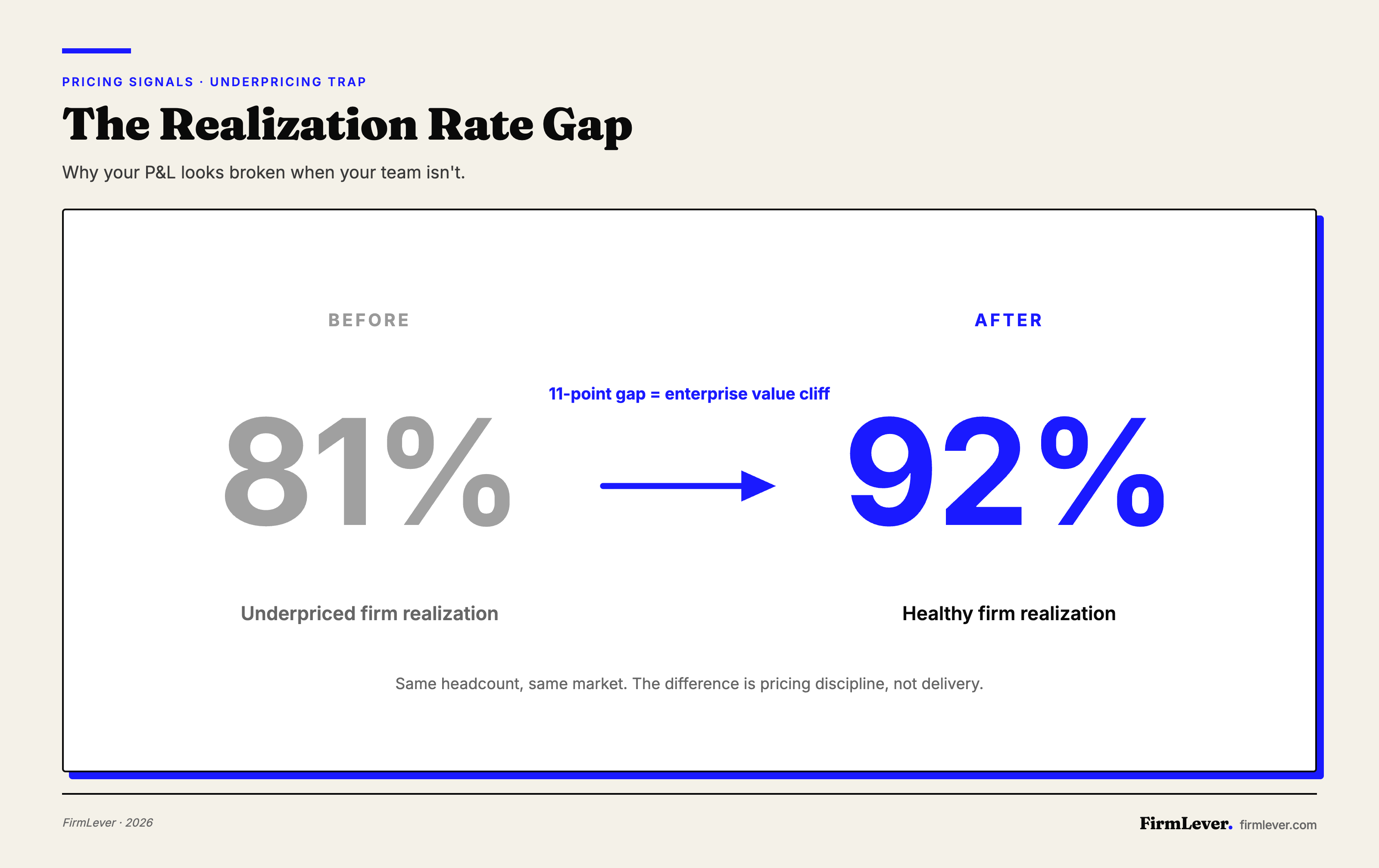
Then one day you look at the P&L and your revenue per FTE is $138K, your realization is 81%, and the partner who built the firm is working sixty-hour weeks to keep the lights on.
That's not a workload problem. That's a pricing problem wearing a workload costume.
This piece covers two things. First, the underpricing indicators most firm owners miss. Second, a sequenced fee increase strategy you can run between now and year-end. Both sit under our broader pricing and valuation work in The Ultimate Accounting Firm Metrics & Valuation FAQ: 150+ Questions Answered (2026 Edition).
The Underpricing Indicators Most Firm Owners Miss
Your firm is underpriced if realization falls below 85% and revenue per FTE sits under $150K. If both are true, you don't have a delivery problem. You have a fee problem.
These are the indicators that show up repeatedly in underpriced firms:
- Realization below 85%. Healthy firms run 90 to 95%. If you're consistently writing down time, the scope is wrong, the rate is wrong, or both. It's almost never a "the team is slow" problem.
- Revenue per FTE under $150K. The 2026 healthy-firm target is $175K to $225K per full-time equivalent. If you're sitting at $138K, you'd need to cut headcount by 20% or raise fees by 25% to get to the floor. Most owners pick the wrong one.
- Same fees for two years or more on the same client. Inflation alone means you're down roughly 7 to 10% in real terms. If the scope grew at all, you're down more.
- No client has ever pushed back on price. If zero clients are uncomfortable with what you charge, you're leaving real money on the table. Healthy pricing should feel like a stretch for 5 to 10% of the book. Some of those clients will leave. That's the system working.
- You discount before the prospect asks. Pre-emptive discounting signals you don't believe your own number. Clients hear it.
- Scope creep with no fee adjustment. The client added two entities. You absorbed it. You added monthly cash flow calls. You absorbed those too. Six months later you're doing 40% more work for the same fee and calling it "relationship building."
- You charge hourly for advisory work. Advisory is judgment work. AI is compressing the value of hourly compliance work and expanding the premium on judgment. If you're billing your highest-leverage thinking by the hour, you're pricing the most valuable thing you do like it's the cheapest.
- Your bottom 20% of clients eat 50% of your stress. Look at who you dread emails from. They're almost always the lowest-paying clients. They're underpriced precisely because they demand the most.
If three or more of those describe your firm, you don't have a marketing problem or a staffing problem. You have a pricing problem.
Your Fee Increase Strategy: A Sequenced 6-Month Playbook
The right fee increase strategy is sequenced, not announced. Repricing the entire book in one letter on January 1 is how you lose your best clients and keep the worst ones. Here's the sequence that works.
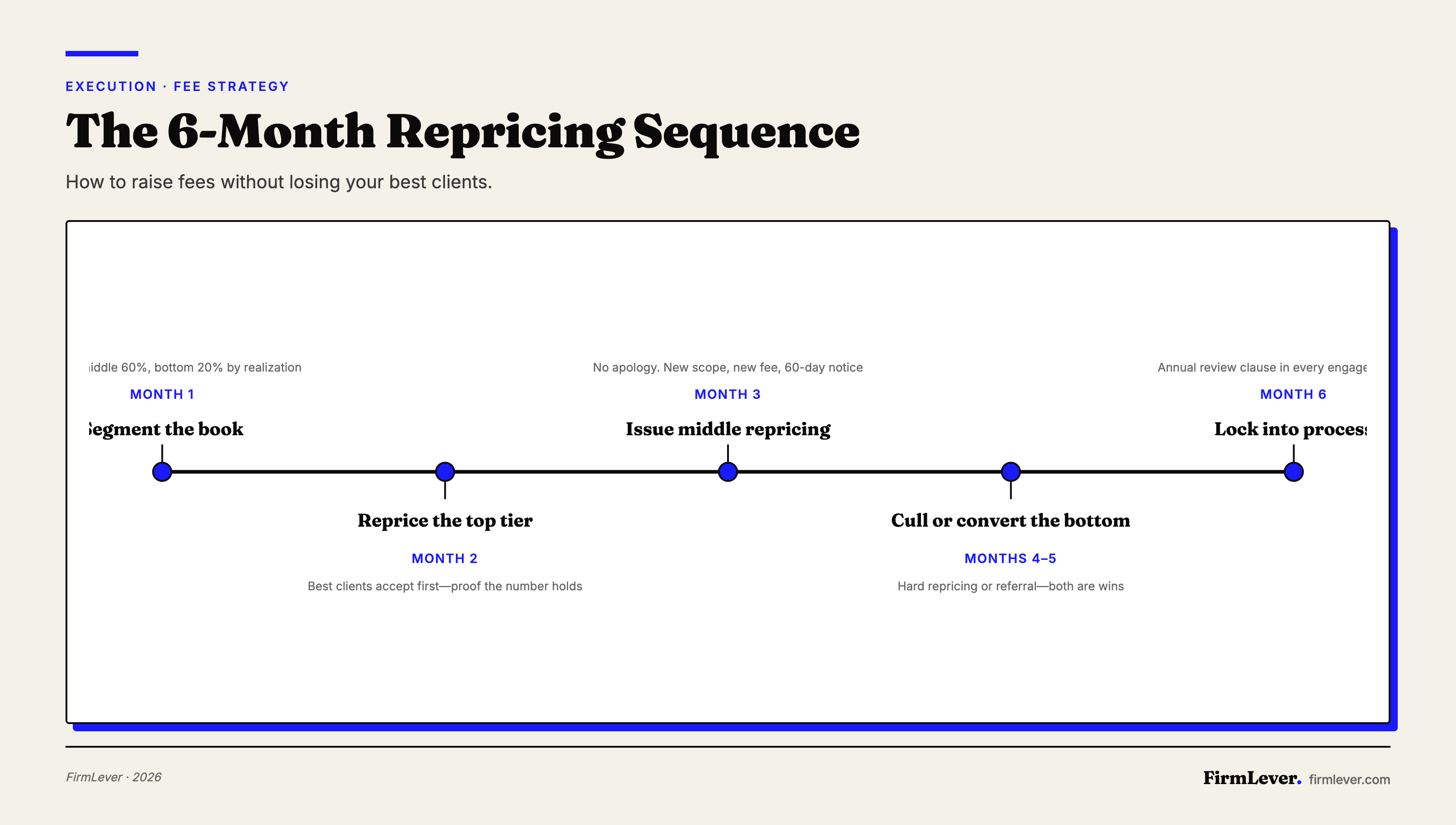
Month 1: Segment the book. Pull every client into a spreadsheet. Three columns: realization, scope complexity, and fit. Tag your top 20%, your middle 60%, and your bottom 20%. The bottom isn't always the lowest-fee clients. It's the lowest-realization clients.
Month 2: Reprice the top tier first. Your best clients are the least likely to leave over a price change because they value the relationship and the work. Lead with them. When they accept, you have internal proof the new number holds. That confidence carries you through the middle conversations.
Month 3: Issue repricing letters to the middle. Don't apologize. Don't over-explain. Tell them the new scope, the new fee, and the effective date. Sixty days notice. The script is short: "We're updating fees across the firm to reflect the expanded work and the current market. Your new annual fee is X, effective March 1. We'd love to keep working together and I'm happy to walk through the scope on a call."
Month 4 to 5: Cull or convert the bottom. This is the part most owners skip. The bottom 20% needs a real conversation. Either reprice them hard, 30 to 50% up, or refer them to a peer who's actually a fit. Both outcomes are wins. If they accept the higher fee, your realization jumps. If they leave, your stress drops and your team gets capacity back. The clients who refuse to leave but also refuse to pay are destroying your firm.
Month 6: Lock it into the engagement letter cycle. Every engagement letter from now on includes an annual review clause. CPI plus scope adjustment. No more 2019 fees in 2027. Once fee increases become process instead of event, the problem stops recurring.
A few rules that hold across all six months:
- Never lead with cost justification. Clients don't care about your wage costs. They care about outcomes and risk reduction.
- Never raise fees and add new deliverables in the same letter. Pick one.
- Always offer a path. "Here's the new fee. Here's the scope. If you'd prefer a leaner package, here's option B." Most clients pick option A. The ones who pick B are honestly telling you what they value, which is useful.
- Track who accepts, who pushes back, and who leaves. After 90 days you'll know exactly where your real pricing power sits.
The firms that run this playbook end the year with the same headcount, 15 to 25% more revenue, lower stress, and a book that's worth materially more if they ever decide to sell a piece of it.
A book with 92% realization and $200K revenue per FTE trades at a different multiple than a book with 81% realization and $138K per FTE. Pricing discipline isn't just an operating decision. It's the single biggest lever on enterprise value most firm owners control.
Fix the pricing. Everything downstream gets easier.
Marc
P.S. — FirmLever is the peer network where pricing-disciplined firms turn that discipline into real transactions. 316 member firms across 43 states, $644M+ in combined annual revenue, and 108 firm-to-firm connections formed so far. Members buy, sell, and refer books of business to vetted colleagues, including the bottom-20% clients you'd rather hand off than reprice. Come see who's in the network.