Effective Hourly Rate and Utilization: The Two Numbers That Price Your Firm
Effective hourly rate isn't just a pricing check. It's the number buyers back into during diligence, and the one that caps what your firm sells for.


Why EHR Is Really a Valuation Metric in Disguise
Every buyer I watch in diligence does the same thing. They pull time data. They divide realized revenue by hours worked. They back into your effective hourly rate whether you track it or not.
That number sets your multiple.
Most firm owners think of EHR as a pricing tool. Am I charging enough for this return. Did we lose money on this client. Useful questions. But the bigger use sits at exit. A firm running at $120/hr EHR gets a different offer than a firm running at $280/hr EHR, even with identical revenue. Same top line. Different businesses.
The formula is simple:
Effective hourly rate = realized revenue ÷ total hours worked
Realized revenue means what actually hit the bank after writedowns and scope creep eaten silently. Total hours means everyone who touched the work, owner included. Not just the hours you billed.
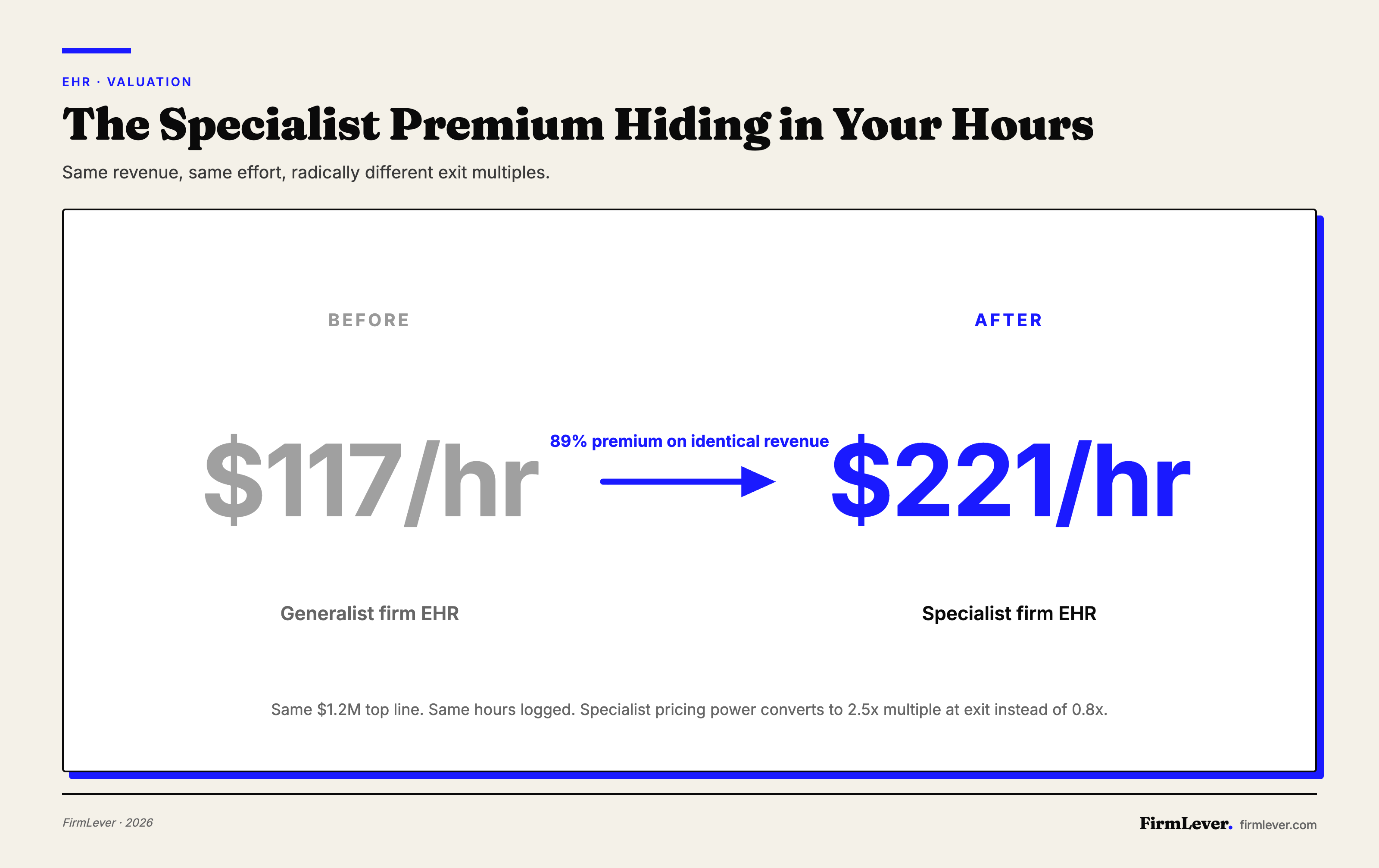
Here is the math most firms do not want to run. A $1.2M shop with 5 FTEs, each logging 1,800 hours on client work. That is 9,000 hours. Realization runs at 88% so realized revenue is $1.056M. EHR comes in at $117/hr. That firm sells for 0.8x to 1.0x revenue, with maybe 40% cash at closing and a three-year earnout. Ugly paper.
Same revenue, different firm. $1.2M in niche SaaS advisory with 3 FTEs at 1,700 hours each. That is 5,100 hours. Realization is 94%, so realized revenue is $1.128M. EHR lands at $221/hr. That firm trades at 1.3x to 1.5x with 60–70% cash at close.
Same top line. Different life.
Segment Your EHR or the Average Lies to You
A firm-wide EHR is the accounting equivalent of saying the average temperature in the US is 58 degrees. Technically true but useless for deciding what to wear in Phoenix.
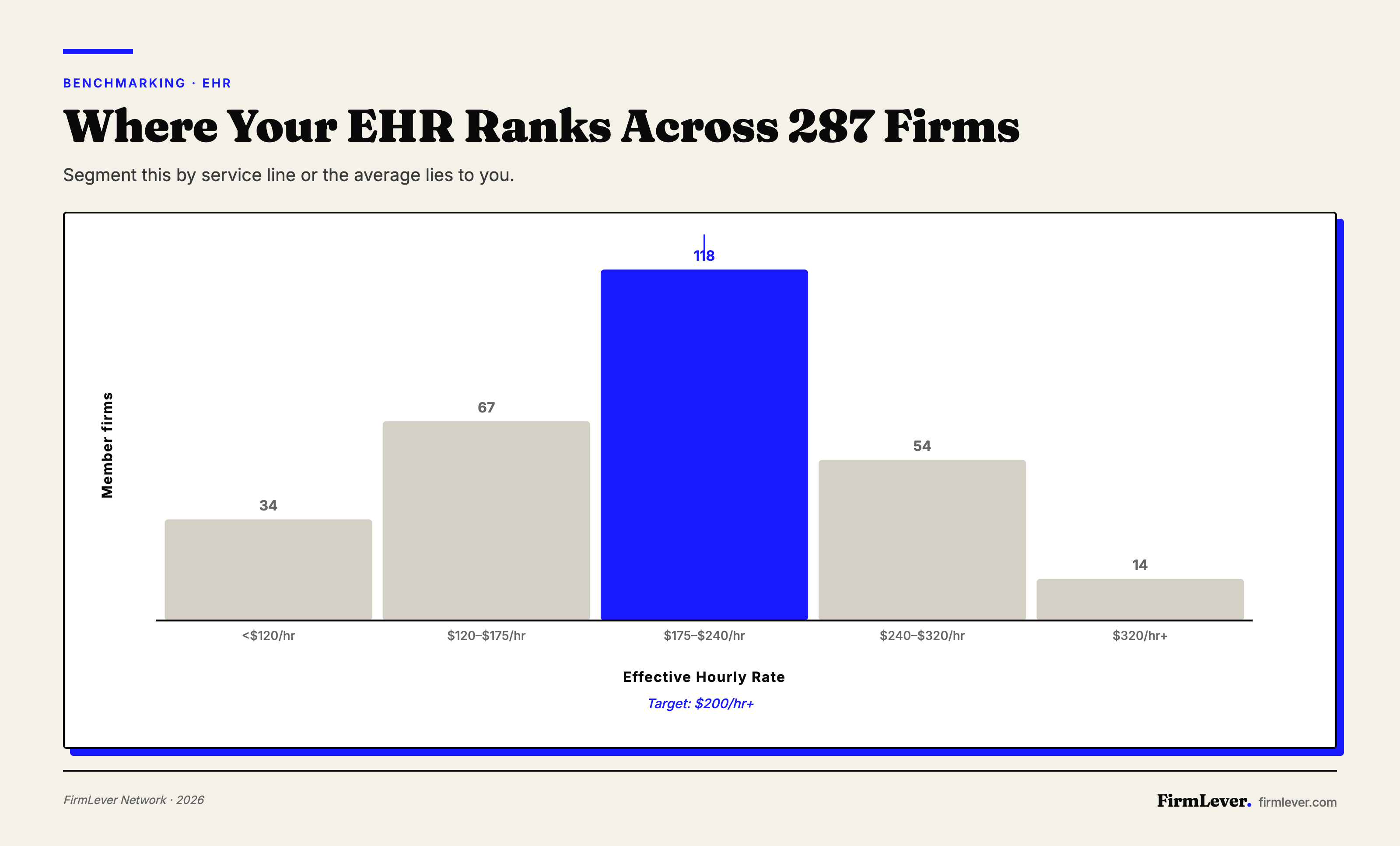
You need EHR by service line at minimum:
- Tax prep and compliance
- Monthly bookkeeping / write-up
- CAS / controller work
- Advisory and fractional CFO
- Transaction and M&A consulting
A Georgia firm I talked to in March looked healthy at $168/hr blended. Segmented, the story flipped. Bookkeeping ran at $78/hr. Tax came in at $145/hr. Their small advisory line was printing $340/hr. The bookkeeping wasn't a profit center. It was a loss leader eating into owner hours.
She was three hires away from fixing it, except the real answer wasn't hiring. It was selling the bookkeeping book and doubling down on advisory. She didn't see it until she segmented the math.
The Specialist Premium Is Real, and It Compounds at Exit
Across the network I watch, specialist firms produce 2x to 3x the EHR of generalists doing nominally similar hours. Cannabis, dental groups, MSPs, ecommerce, construction, SaaS. The work isn't harder, but the pricing power is radically different.
A solo practitioner in upstate New York doing general 1040s and S-corps tops out around $110/hr no matter how hard he grinds. A solo in Denver doing cannabis compliance clears $385/hr. Same credential. Same hours. Different game.
That premium shows up at the closing table. Buyers pay meaningfully more for firms above $200/hr EHR because they know the book will hold up under a new owner. A generalist book depends on the owner's relationships and local trust. A specialist book depends on the specialty, which transfers. That's why the multiple jumps.
Utilization Math for Owners Who Still Do Client Work
Utilization is billable hours divided by available hours. Healthy weekly targets run 75–85% for production staff. Annually, 70% is the real ceiling once you account for training, admin, and PTO.
Owners get a pass on the number but not on the consequences.
Here is the trap. Owner does $400/hr M&A diligence work in the morning. Owner does $80/hr bank reconciliations in the afternoon because nobody else picked them up. Firm-wide EHR gets computed. The number looks mediocre. The owner concludes the firm is underperforming. Wrong diagnosis.
The firm isn't the problem. The owner is.
I tell partners to track two utilization numbers. Team utilization. And owner hours spent on sub-$150/hr work. That second number should be under 15% of your week. If it is 40%, you are the bottleneck. You are also capping your firm's sale value, because a buyer looks at owner-dependent hours and discounts accordingly. Partner-dependent firms trade at 0.6 to 0.9x revenue. Team-centric firms trade at 1.2 to 1.5x.
That's half a million dollars on a $1.5M book, just from the owner doing bank recs.
When Low EHR Means Sell, Not Fix
Sometimes the EHR is low because pricing is bad. Raise fees. Problem solved.
Sometimes the EHR is low because scope is bad. Tighten engagement letters. Problem solved.
And sometimes the EHR is low because the work itself is commoditizing faster than you can reprice. Basic bookkeeping. Simple 1040s. Data entry dressed up as advisory. No amount of tooling fixes a segment the market has decided is worth $60/hr.
That is the pruning decision. When a client segment consistently runs below $120/hr after two pricing cycles, you have three moves:
- Offload the work to a cheaper team or offshore pod
- Refer the clients to a peer whose cost structure fits the price point
- Sell the book outright and redeploy the hours into higher-EHR work
Option three is the one most partners never consider. I watched a Philadelphia CPA sell a $190K bookkeeping book last quarter for 1.1x revenue. She took the proceeds, hired a senior advisor, and converted the freed-up owner hours into a fractional CFO line running at $310/hr. Net change to her firm's valuation in twelve months: roughly $400K.
The book didn't need fixing. It needed an owner who could live with that margin.
A 90-Day Dashboard for Firms Under $5M
You do not need a BI stack. You need six numbers on one page.
Weekly:
- Team utilization, target 75–85%
- Realization on fixed-fee work, target 90–95%
- Owner hours on sub-$150/hr tasks, target under 15%
Quarterly:
- Firm-wide EHR, target above $200/hr
- Top-10 client concentration, capped at 40% of revenue
- Revenue per FTE, target $175K–$225K
Run that for two quarters. You will know which clients to reprice, which segments to prune, and whether your exit value is rising or eroding.
Those six numbers are what a buyer reconstructs in diligence anyway. Better to know before they do.
Marc
P.S. — FirmLever is where firms turn EHR discipline into real peer transactions. Members list books of business, refer client segments they shouldn't be holding, and buy the specialty work that actually clears $200/hr. 287 member firms across 43 states, $618M+ in combined revenue. If you have a segment pulling your number down, the network is live.