The Underpricing Trap: How to Spot It and Fix It This Quarter
Most firms I talk to are underpriced by 20% or more and don't know it. Here's how to read the signals and raise fees without losing your best clients.


You are probably underpriced by 20%
Not 5%. Not 10%. Twenty percent, minimum.
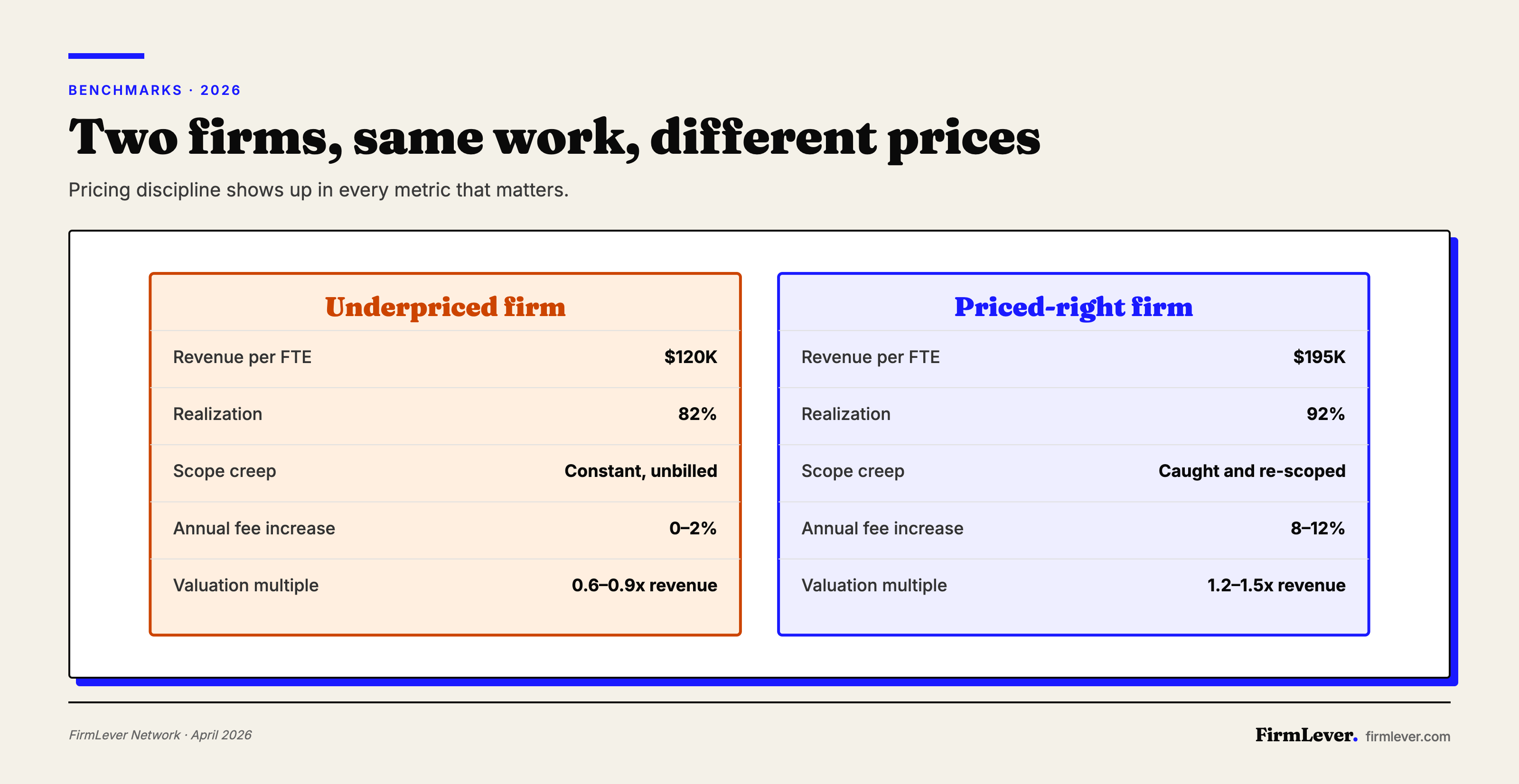
I say this because I see the numbers every week. Firm owners tell me they're "priced about right" and then show me a P&L that says otherwise. Realization at 82%. Revenue per FTE at $120K. Clients who haven't had a fee increase since 2022.
That's not "about right." That's a firm giving away 20% of its enterprise value.
Pricing is the single highest-leverage decision you'll make this year. It sets your margins, your hiring budget, your multiple at exit, and whether your best people stay. Get it wrong and every other problem in the firm gets harder. Get it right and most of them quietly go away.
This is the underpricing trap. Let's talk about how to spot it and how to get out.
The signals your firm is underpriced
Your firm is underpriced when your realization drops below 85%, your revenue per FTE sits under $175K, and scope creep goes unbilled. Those three signals together are a near-certain diagnosis.
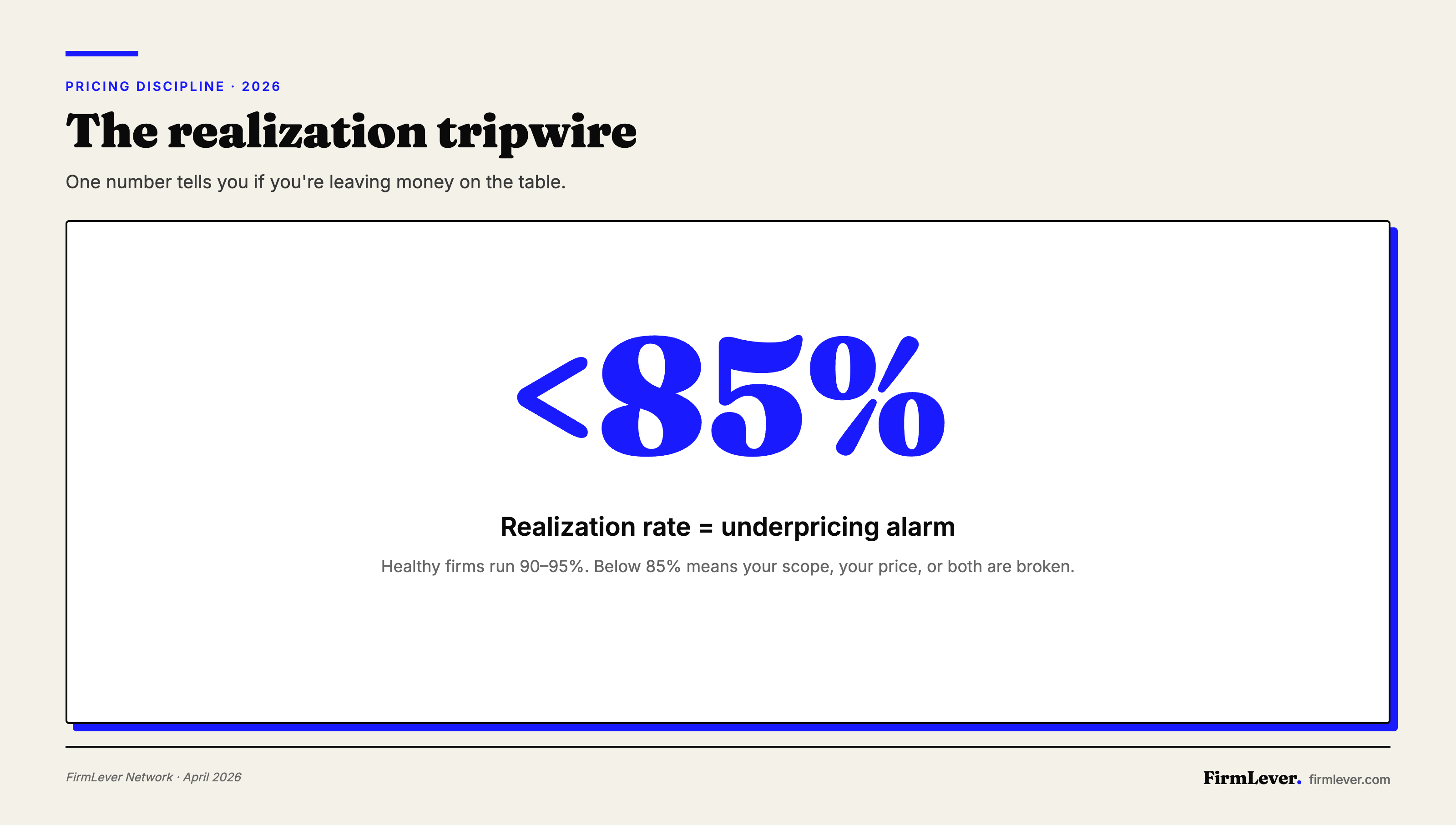
Here are the indicators I look at, in order:
- Realization under 85%. Healthy firms run 90–95%. If you're writing down 15% or more of your time, you either scoped the job wrong or priced it wrong. Usually both. This is the loudest alarm in the building.
- Revenue per FTE under $175K. Healthy firms run $175K–$225K per full-time employee. Under $175K and you're either overstaffed, underpriced, or working on commodity engagements that should be repriced or repositioned. Under $150K is a five-alarm fire.
- Flat fees for three-plus years on the same client. Inflation alone ate 15% of your real fee. If the client's revenue grew and the work grew with it and your fee didn't move, you're subsidizing them.
- Scope creep you absorb instead of bill. Every "quick question" that turns into three hours. Every extra entity you picked up "as a favor." If your engagement letter hasn't been refreshed in two years, your scope is fiction.
- Clients who never push back on price. Counterintuitive, but real. If nobody ever flinches at your invoice, you're leaving money on the table. You want 10–15% of prospects to say no on price.
- Your best staff are quietly leaving. Underpriced firms can't pay competitively. Talent knows. They leave before you figure out why.
- You can't remember the last time you fired a client. Underpriced firms are afraid to lose anyone because every dollar counts. That fear is the trap.
Any two of these and you have a pricing problem. Three or more and you have a pricing emergency.
Low fees fund low margins. Low margins fund low wages. Low wages fund weak talent. Weak talent funds commodity work. Commodity work funds low fees. The whole thing runs backward until something breaks.
The fee increase strategy that actually sticks
The fee increase strategy that works is segmented, communicated in writing 60–90 days ahead, and paired with scope clarity so clients see what they're paying for. Across-the-board 5% increases are the slowest, most painful way to fix the problem.
Here's how I'd run it this quarter.
1. Segment the book first. Before you touch a single fee, sort every client into four buckets: A (profitable, easy, strategic), B (profitable, some friction), C (break-even, high-maintenance), D (losing money, draining the team). You can't price if you don't know who you're pricing.
2. Apply different increases to different segments. A clients get a 5–8% bump and a warm conversation. Keep the relationship rock-solid. B clients get 10–12%, plus a re-scoped engagement letter to clean up the creep. C clients get 20–30% or a re-scoped engagement that properly prices the friction. D clients aren't getting a fee bump. You're either firing them or charging what you'd actually need to want the work, which usually means 40–60% more. Half will leave. That's the point.
3. Communicate in writing, 60–90 days out. No surprise invoices. Send a letter explaining what's changing and why. Reference the scope. Reference the value. "Effective with your next engagement, our fee for this work will be X." That's the sentence.
4. Pair every increase with scope clarity. New engagement letter. Clear list of what's included. Clear list of what triggers additional fees. This is why increases stick. Clients don't resent paying more for work they understand. They resent paying more when the goalposts moved.
5. Raise your floor for new clients immediately. Don't wait for the annual cycle. Every proposal you send from today forward prices at the new rate. Your book repricing takes a year. Your new-client pricing takes an afternoon.
6. Track what moves. After the increase lands, watch realization, revenue per FTE, and client retention. Healthy outcome: realization climbs toward 92%, revenue per FTE climbs toward $195K, and you lose 5–10% of clients, mostly from the C and D buckets. If you lose nobody, you didn't raise enough. If you lose 25%, your communication was weak, not your pricing.
One more thing. The fear of losing clients is what keeps most firms in the trap. A 12% fee increase with 8% client loss is a 3% revenue gain with 8% fewer headaches, higher margin, and better staff retention. That math is not close. Run it for your own firm before you decide you can't afford to move.
What this buys you at exit
Pricing discipline is also the single biggest lever on your valuation multiple.
Partner-dependent, generalist firms trade at 0.6–0.9x revenue. Team-centric, systematized firms trade at 1.2–1.5x. Cloud-native specialists go to 1.3–1.8x. The firms at the top of that range all have one thing in common: they charge more, they collect more, and they document why.
A $2M firm priced at 0.8x is worth $1.6M. The same firm, repriced and systematized, at 1.4x is worth $2.8M. That's $1.2M of enterprise value sitting in your engagement letters and your willingness to charge for what you do.
If you want the deeper map of metrics that move valuation, I keep it here: The Ultimate Accounting Firm Metrics & Valuation FAQ.
Fix the pricing. Everything else gets easier.
Marc
P.S. — FirmLever is where pricing-disciplined firms find each other. Members buy, sell, and refer books of business to vetted colleagues, not cold leads. 286 firms across 43 states, $276K in active listings, and 199 firms still waiting to get in. If you've fixed your fees and want to see what's moving in the network, the marketplace is live.