Juno Just Raised $12M to Automate 90% of Your Tax Prep. Here's What That Actually Means for Your Firm.
A new AI tax prep tool just raised $12M promising to cut return time in half. The interesting question isn't whether it works. It's what happens to your billable model when it does.


Juno just raised $12M. Read this before you panic or yawn.
CPA Practice Advisor reported this week that Juno, a tax prep automation platform, closed a $12M seed round led by Bonfire Ventures. The pitch: automate 90% of the data entry across 92+ document types, cut prep time per return by 50%, keep a human in the loop.
I have opinions. Some agree. Some don't.
Start with what's right. Clear box automation is the right call. CPAs cannot ship a return they can't defend. Source-to-return traceability is the only honest way to deploy AI in tax. Every vendor that doesn't offer it loses.
The customer quote in the article stands out. Molly Sutz at BlueSky Wealth Advisors went from 2–3 returns a day manually to "double or triple that." Call it 6 returns a day instead of 2. That's not a productivity bump. That's a different business.
Now here's where I push back.
The $12M isn't the story. The pricing model is.
The article frames this as a time-saver: "Spend 50% less time per return." It sounds great until you run the numbers.
If you bill hourly and you cut prep time in half, you just cut your revenue per return in half. The software vendor takes a subscription fee, the client gets a faster return, and you got smaller. That's the trap.
The firms that win with tools like Juno already moved to fixed fees or advisory packages. When prep hours drop, the fee stays the same and the margin expands.
If you're a $500K–$5M firm still billing 1040s by the hour in 2026, this round of funding is a warning. Your competitor down the road is going to use it, drop fees 20%, and still make more money per return.
The math your firm needs to do this week
Start here:
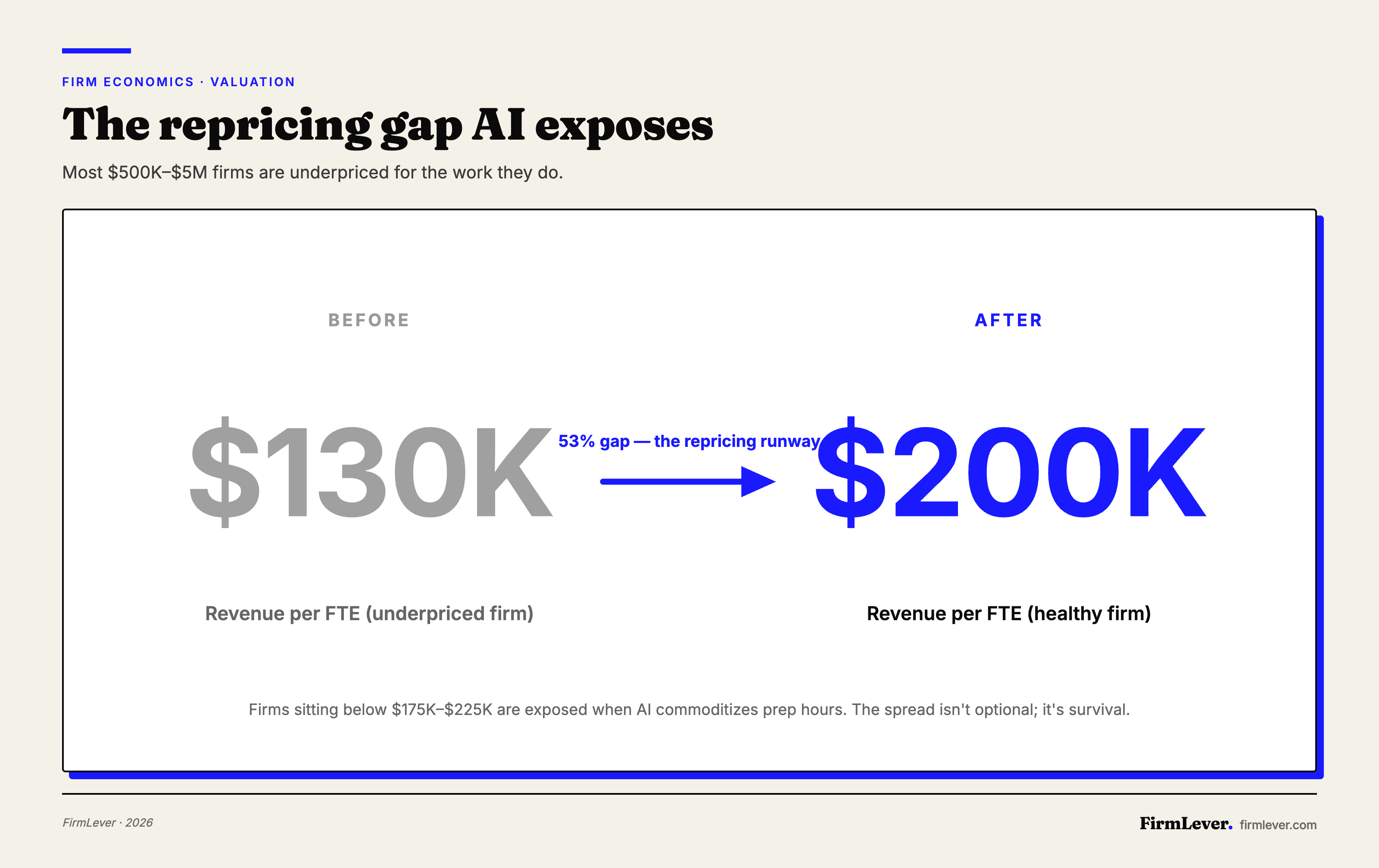
What percentage of your revenue is tied to prep hours that AI is about to compress? In most $500K–$5M firms, that number is 40–60%. That's the chunk of your P&L getting repriced over the next 24 months whether you participate or not.
Healthy revenue per FTE in 2026 is $175K–$225K. If your firm is sitting at $130K per head, you're not running lean. You're underpriced and over-staffed for the work you're doing. Juno exposes this.
Realization rate below 85% means your scoping or pricing is broken. AI automation makes that gap bigger, not smaller—you're doing underpriced work faster and burning the saved hours on more underpriced work.
What I'd actually do
Three concrete moves:
- Reprice your 1040 and 1120-S work to fixed fees this off-season. Build the fee around the value of the return, not the hours. When automation hits, you keep the spread.
- Identify your top 20 clients and ask what advisory work you're not currently doing for them. Tax planning. Entity structure review. Cash flow forecasting. The hours AI gives back only matter if you have somewhere to redeploy them. If you don't, you have an idle staff problem.
- Stop doing the work that AI is about to commoditize at a price that requires you to do it. Firms quoting $400 1040s in 2027 competing against $250 quotes with Juno-style tools lose on price. Move up the value chain and you win.
What this means for firm value
The valuation impact is what the article misses.
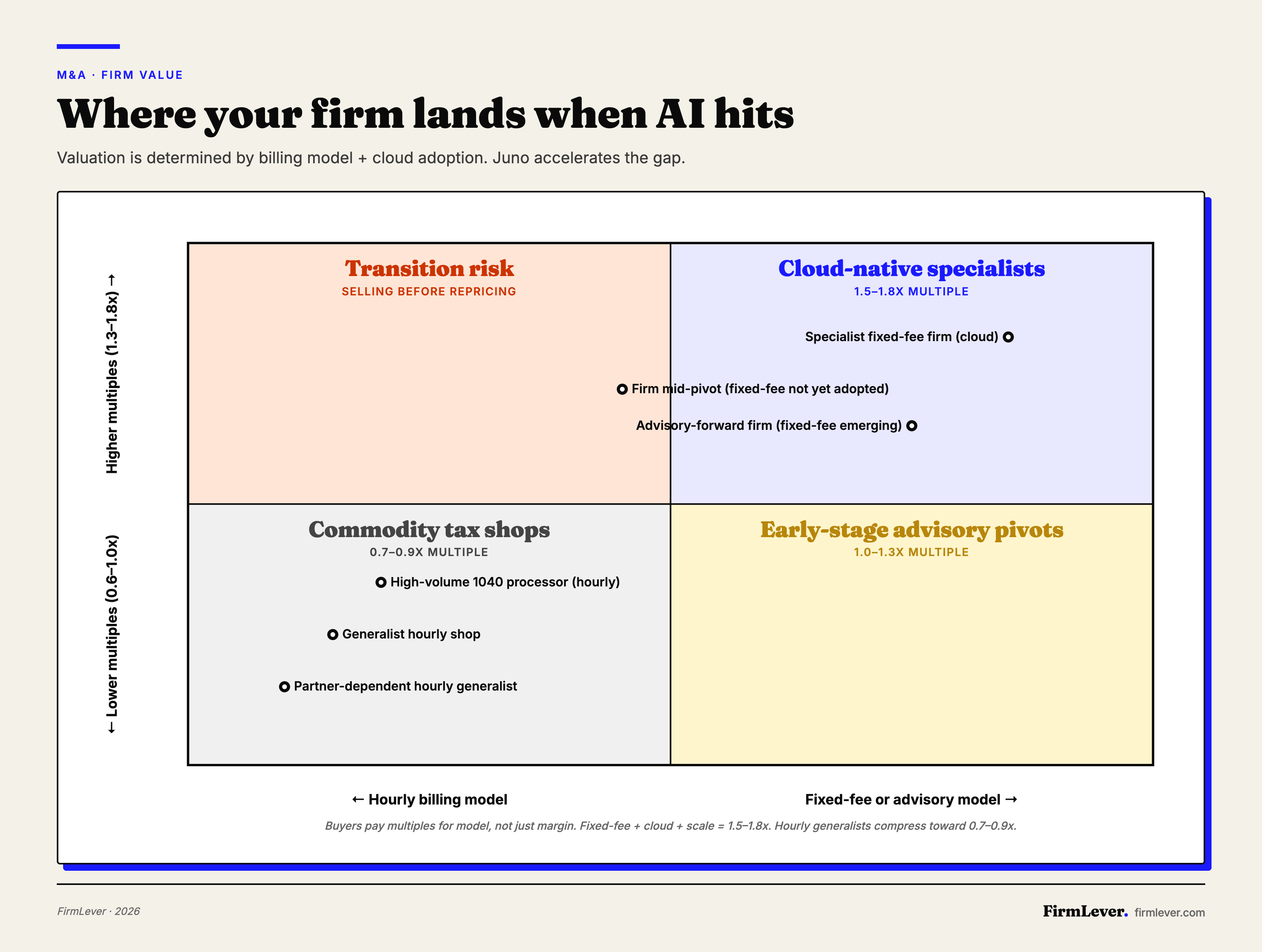
Cloud-native, systematized firms already command 30–50% higher multiples than non-cloud peers. Firms that integrate AI into the prep workflow and shift to fixed-fee or advisory billing extend that gap. Specialist tax-advisory firms are trading at 1.5–1.8x revenue now while generalist hourly shops compress toward 0.7–0.9x.
That's happening in the books moving on the network right now. Buyers pay up for systematized, repeatable, software-native books. They discount partner-dependent hourly shops hard.
The $12M round signals that capital is flowing toward tools that make your billable hour worth less. Firms that haven't repriced are running out of runway to do it before a buyer notices.
Marc
P.S. — FirmLever is the peer network where firms that have already moved up the value chain transact with each other. Members buy, sell, and refer books of business to vetted colleagues across our 287 admitted firms representing $618M+ in combined annual revenue. If you're rethinking what your tax book is worth in an AI-priced world, come see what's moving in the network.