Accounting Firm Underpricing Indicators: 9 Signs You're Leaving Money On The Table
Nine concrete signals your firm is underpriced, from realization rates to scope creep. If three or more apply, you're probably 20 to 40 percent below market.

The clearest accounting firm underpricing indicators are a realization rate under 85 percent, a client acceptance rate above 95 percent, scope creep on more than a third of engagements, fees that haven't moved in two years, and partners still doing work a senior should handle. If three or more of these apply to your firm, you're almost certainly priced 20 to 40 percent below market.
I talk to firm owners every week who tell me pricing is fine. Then I ask what their realization is. They don't know. Or they know and it's 72 percent. That's not fine. That's a firm quietly giving away a partner's salary every year.
Accounting Firm Underpricing Indicators
Here are the nine signals I watch for. Some are quantitative. Some are behavioral. They all tell the same story.
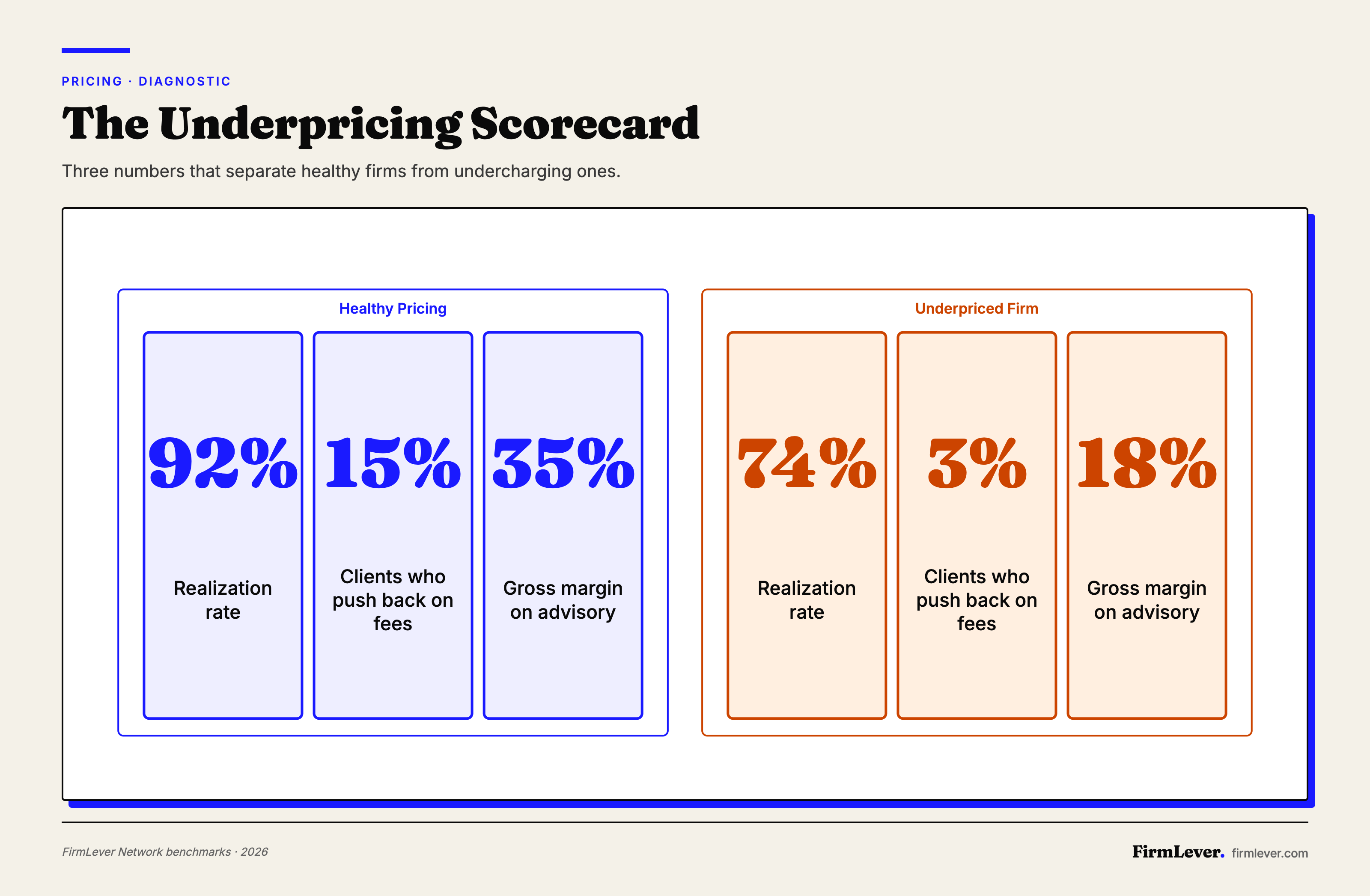
1. Realization rate below 85 percent. If you're writing down 15 cents on every dollar of work, your rack rate is fiction. Healthy firms run 90 to 95. Anything under 85 means your scoping, your pricing, or both are broken.
2. Acceptance rate above 95 percent. Nobody ever says no. This feels like a good problem. It isn't. If every prospect signs, your price is too low. Some pushback is a sign the market is testing you. No pushback means you're testing nothing.
3. Scope creep on more than a third of engagements. Clients asking for "one more thing" and getting it for free is a tax you pay on your own margin. Track it. If more than 35 percent of your jobs blow past original scope with no change order, your pricing model is a subsidy.
4. Fees haven't moved in two or more years. Wages are up. Software is up. Your landlord didn't forget to raise rent. If your standard fee for a business return is the same number it was in 2023, you gave yourself a real pay cut.
5. Partners doing senior-level work. When the owner is reconciling bank feeds at 9pm, the firm isn't understaffed. It's underpriced. You can't hire the next level up because the fees don't support the salary. So the owner absorbs it.
6. No tiered service offering. One price, one package, every client. This is a tell. It means you haven't segmented. Which means your best clients are subsidizing your worst, and your worst are paying the same as your best.
7. You lose on price less than 10 percent of the time. I hear this a lot. "We never lose on price." Good firms lose on price sometimes. It means they're anchored high enough to matter. If you never lose, you're the cheap option by default.
8. Advisory fees calculated from hours. Any firm pricing CFO services or advisory at "senior rate times hours" is leaving 30 to 50 percent on the floor. Advisory is priced on value. If you're billing $275 an hour for work that moves a client's EBITDA by $400K, you priced a Ferrari like a Honda.
9. Your block would sell for less than 1.0x revenue. Buyers in the FirmLever Network pay 1.0 to 1.3x for clean, well-priced books. They pay 0.7 to 0.9x for books with realization problems and fee compression. The multiple buyers offer you is the market telling you what your pricing is worth.
Why Firms End Up Here
None of this happens because owners are bad at math. It happens because pricing is uncomfortable and the feedback loop is slow. A fee set in 2019 feels normal in 2026. A client who hasn't had a raise in three years feels like a relationship, not a liability.
And the profession trains us this way. We grew up watching partners round down, absorb the extra hour, keep the client happy. That worked when inflation was 2 percent and wages were flat. It doesn't work now. Senior staff cost 40 percent more than they did four years ago. If your fees haven't moved in step, the math isn't mysterious. Your margin left.
AI makes this worse, not better. When a tool cuts 30 percent of the hours out of a bookkeeping engagement, the firm that bills hourly just cut its own revenue by 30 percent. The firm that priced on value kept the entire upside.
The Diagnostic I Run
When a firm owner asks me whether they're underpriced, I ask four questions.
- What's your realization rate on your top 20 clients, specifically?
- When did you last raise fees on a client you've had more than five years?
- What percentage of your revenue is fixed-fee or value-priced versus hourly?
- If you lost your three smallest clients tomorrow, would your profit go up or down?
That last one is the killer. In underpriced firms, the answer is "up." Small clients at underpriced rates are usually loss leaders nobody labeled as such. The owner has been working for free on accounts that feel like favors.
What To Do This Quarter
You don't fix underpricing with a firm-wide memo. You fix it with a sequence.
First, pull the realization number by client. Not the average. The list. The bottom quartile is where your profit went.
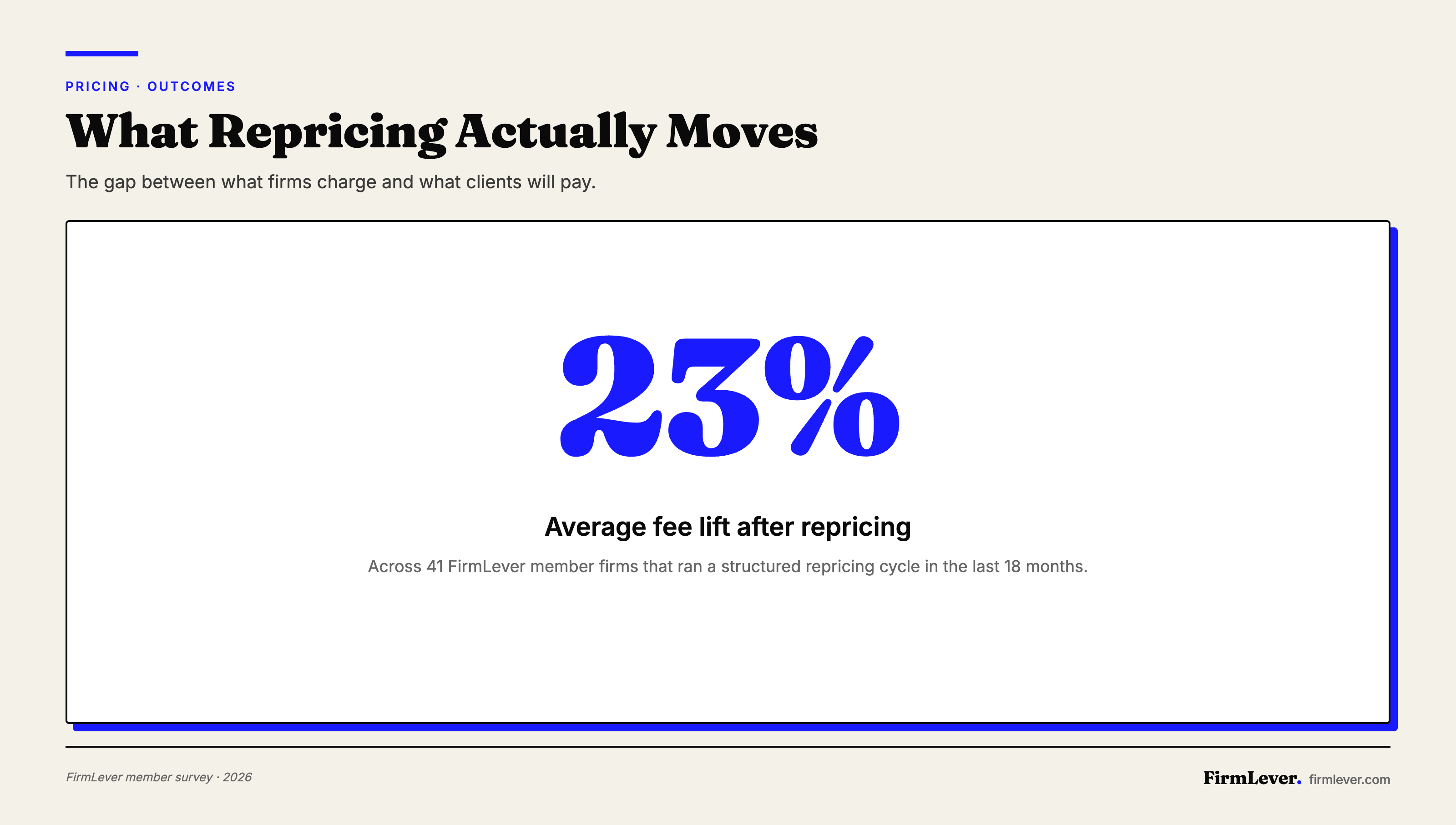
Second, pick your 10 most underpriced engagements and send a fee adjustment letter this quarter. Not next year. Build in a 15 to 25 percent lift on the ones that have been flat for three or more years. You will lose one or two. That's the point.
Third, kill hourly pricing on anything advisory. Move to fixed monthly fees tied to outcomes or scope. If you can't articulate the outcome, you can't price the outcome, and that's a scoping problem before it's a pricing problem.
Fourth, put the worst 10 percent of your book up for sale. Seriously. In the FirmLever Network, underpriced small-client blocks move fast because buyers can reprice them on intake. You get capital. The clients get served. You free up capacity to raise fees on the book you keep.
The firms I watch grow the fastest aren't the ones winning new logos. They're the ones who looked at their existing book, admitted it was underpriced, and did something about it in 90 days.
Marc
P.S. — If your bottom-quartile clients are dragging the whole firm down, list that block on FirmLever and let a buyer reprice it for you. Get in now.