Why the White-Label Tax Prep Model Is Eating the Midmarket
The margin math of why more U.S. firms are running a front-office/back-office split with offshore prep partners.


Every week I talk to firm owners who are secretly running two different firms inside one.
The front has U.S. partners, advisory conversations, and a polished client experience.
The back has a team in Bangalore or Manila turning returns around in 36 hours. The client sees one invoice. The P&L tells a very different story than it did three years ago.
This is the white-label tax prep model. In 2026, it's no longer a fringe play. For firms in the $1M–$5M range, it's becoming standard if they want to keep their margins intact over the next five years.
I want to walk through why this is happening, how the numbers actually shake out, and what it means for the firms that don't move.
Why 2026 Is the Tipping Point
Three things converged this tax season.
Staffing
The AICPA's 2025 pipeline report showed accounting graduates down again year over year, and the average U.S. tax prep salary in metro markets crossed $82K for a 2-year senior. That's the permanent cost of labor.
Technology
Secure client portals, SOC 2 offshore providers, and workflow tools like Canopy, Karbon, and TaxDome made the handoff invisible to the client. Five years ago, offshoring felt risky. Today, the tooling makes it almost boring.
AI and Automation
AI absorbed the bottom 20% of prep work — the data extraction, the bank feed categorization, the K-1 input. That actually made offshore MORE valuable, not less. Because now your offshore team isn't doing keystrokes. They're running AI-assisted first-pass prep and flagging exceptions. The productivity per offshore FTE roughly doubled between 2023 and 2026.
The math is simple: a U.S. partner can now oversee 800–1,200 returns a season instead of 300–400.
The Margin Math That Prints
Here's what firm owners whisper about at conferences and won't put in writing.
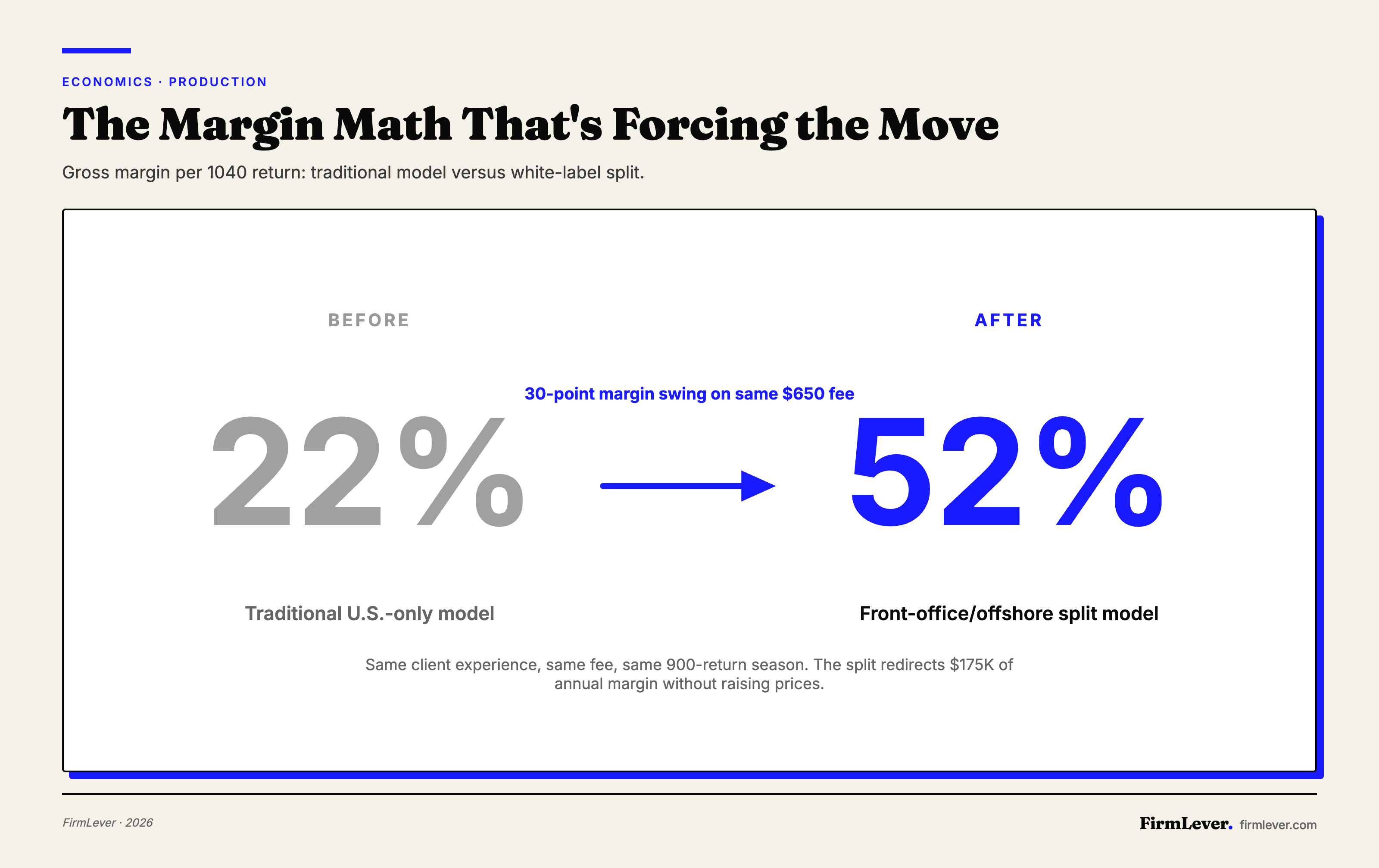
A traditional $650 1040 in a U.S.-only shop runs roughly:
- $280 in U.S. prep labor (senior or mid-level)
- $140 in review and partner time
- $90 in tech, occupancy, and overhead
- Leaving about $140 of gross margin, or ~22%
The same $650 return run through a front-office/offshore back-office model:
- $85 in offshore prep cost (fully loaded, including PM oversight)
- $140 in U.S. review and partner time (unchanged — this is the value)
- $90 in tech and overhead
- Leaving about $335 of gross margin, or ~52%
Same fee. Same client experience. More than double the margin per return.
Multiply that across 900 returns in a season. You just moved $175K of margin without raising a single fee or firing a single person. You redirected the work.
That's why firms are moving. Not because they love offshoring. Because the arithmetic stops being optional.
What Actually Moves Offshore
Most owners get the model wrong. They assume it's all-or-nothing, and it isn't.
The split works because judgment stays home and production goes abroad. Data entry, first-pass prep on 1040s and business returns, workpaper construction, bookkeeping cleanup, and fixed-asset roll-forwards all move. Review, advisory, planning, sign-off, IRS representation, and every client-facing conversation stay onshore.
Firms doing this well treat offshore as a production floor, not a brain. They document SOPs aggressively. They have a U.S. lead reviewer for every offshore pod. They never let offshore touch the client directly. Firms doing it badly try to offshore judgment work, then lose clients when a complex K-1 gets treated like a data-entry ticket.
The Capacity Dividend
Here's what doesn't show up in the margin table but matters more.
A firm running the split model with 900 returns at 52% margin has enough cash to do two things a traditional firm can't:
One, hire a dedicated advisory or CAS lead to push the client base up-market. Two, reinvest in partner time spent on high-value planning work that bills at $400–$600 an hour instead of $180.
I've watched several FirmLever members do this this past busy season. They went from $1.4M revenue at 18% partner take-home to $1.8M revenue at 34% partner take-home, with fewer total staff. The engine was the offshore split funding an onshore advisory build.
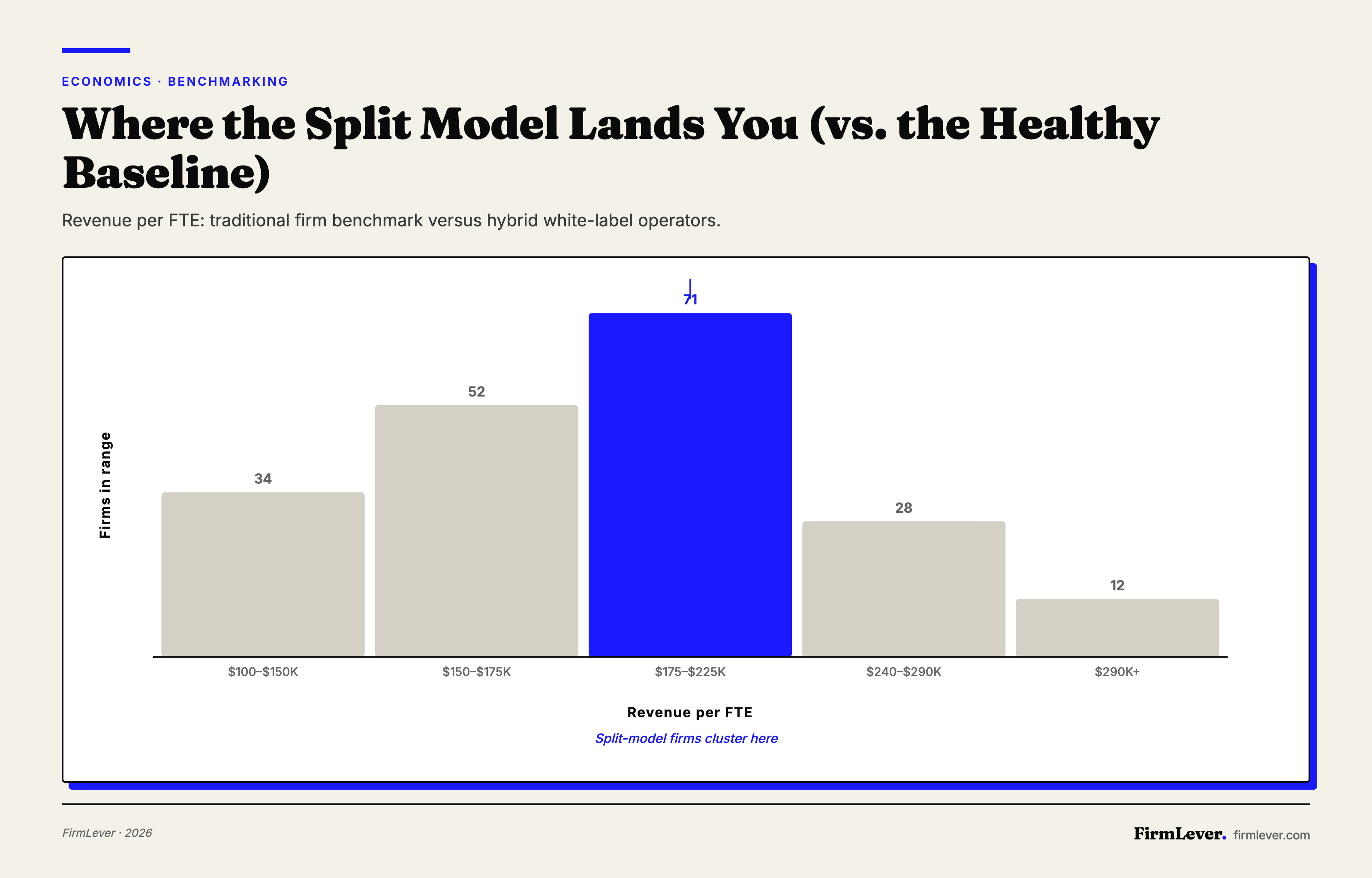
Revenue per FTE in these hybrid firms now lands in the $240K–$290K range. The healthy-firm benchmark is $175K–$225K. The split model isn't incrementally better but a different economic tier.
The Valuation Angle Nobody Mentions
A firm that is partner-dependent, all-U.S., hourly-billing, and carrying 60% prep labor trades at 0.6–0.9x revenue. A firm with documented SOPs, offshore production, a U.S. advisory front, and stable recurring fees trades at 1.2–1.5x.
Same client base. Same fees. Different business model. Fifty to eighty percent higher exit value.
When I talk to firm owners thinking about a transition in the next 5–7 years, this is the conversation I push hardest. The production model you choose in 2026 is the valuation you see in 2031.
The Risks Worth Naming
The model has real downsides. Three things go wrong.
Data security
If your offshore provider isn't SOC 2 Type II with documented data residency, you are one breach away from a Wall Street Journal headline. Pick carefully.
Review discipline
The offshore model only works if U.S. review is rigorous. Firms that rubber-stamp offshore prep to save time end up with error rates that destroy client trust.
Client disclosure
Most states require it in some form. Get your engagement letters right. Don't cut corners here.
What I'd Do This Quarter
If you're running a traditional all-in U.S. firm, three moves between now and June:
Pilot one offshore pod on 50–100 returns for extension season. Not full migration. A pilot. Measure quality, turnaround, and true loaded cost.
Document your top five SOPs. If they live in your senior's head, offshore will fail. If they live in a wiki, offshore scales.
Rebuild your fee model around value, not hours. The split model only prints money if you're not discounting yourself with hourly billing.
The firms that move on this in 2026 will command higher valuations in 2029. The ones that don't will likely face succession challenges.
Marc
P.S. — FirmLever is where firms running the split model meet buyers, referral partners, and peers who actually understand the operating change. With 295 member firms and $628M+ in combined revenue, the network is where the next-generation firm model gets bought, sold, and referred. If you're rebuilding your production stack and want peers who've done it, the network is live.