Accounting Firm Pricing Strategy: How to Increase Fees, Fix Margins, and Stop Leaving Money on the Table
Underpricing is the most common profit leak I see when firms run their numbers on FirmLever. The fix isn't a blanket rate hike, it's a sequenced strategy that protects retention while recovering margin fast.

A member called me last month.
He runs a $1.8M tax and advisory shop in the Southeast, two partners, eleven staff.
I learned that he wanted to talk about selling a small block of clients on FirmLever to clean up his book before a possible internal succession.
Halfway through the call, I asked him what his top ten clients paid him last year. He pulled up the list. Then I asked him what those same ten clients paid him three years ago.
The numbers were almost identical. Same fees. Three more years of work. One client had grown into a $40M revenue business and was still paying what they paid when they were $9M.
He said, "I think I've been giving away about $200,000 a year."
He had. Probably more. And he is not unusual. He is the median FirmLever member when I look under the hood.
Accounting firm underpricing indicators
Before you can fix pricing, you have to know if you have a problem. Most owners I talk to think they don't. Then we look at the data.
The signals I watch for:
- Realization below 85 percent on recurring work. Healthy firms run 90 to 95 percent. If you are writing down hours every month, the fee is wrong, the scope is wrong, or both.
- Top clients paying the same fee for three or more years while their business has grown. This is the most common leak by a wide margin.
- Scope creep with no change order. The client added a second entity, a new state, monthly meetings. You added work. The fee did not move.
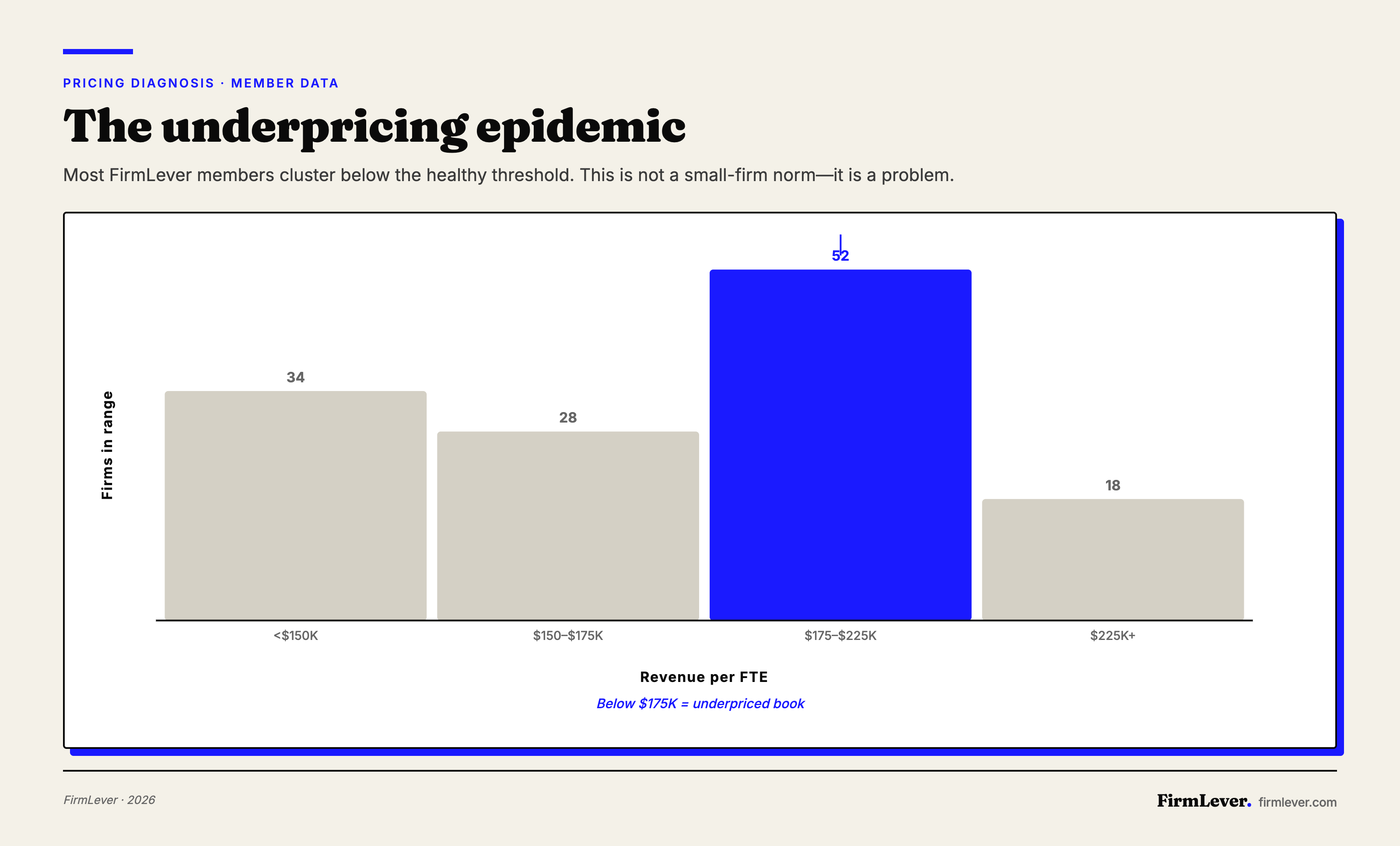
- Revenue per FTE under $150,000. Healthy firms in 2026 run $175,000 to $225,000 per FTE. Anything under $150,000 is an underperforming book, not a small-firm norm.
- Fixed fees set when the engagement started and never indexed. Even a 3 percent annual bump compounded would have you in a different place.
- Owners doing $400/hour work for $150/hour clients. If you cannot say what each client pays per partner hour, you are guessing.
- A discount you gave once that became permanent. Every firm has these. The "first-year friend rate" that is now in year seven.
If you have three or more of these, you are underpriced. The question is not whether. It is how much.
Accounting firm pricing strategy
Pricing is a system. The firms I see win on pricing all do four things in sequence.
One: segment the book. Every client falls into one of four buckets: A players, who pay well and are easy to serve; B players, who pay reasonably and are stable; C players, who pay below market or expand scope; and D players, who are unprofitable. You cannot price the book until you know what is in it.
Two: define the deliverable. Most underpricing is actually scope confusion. The client thinks they are buying X. You are delivering X plus Y plus Z plus a 9pm text. Write down what is included and what is not. This is where most firms find their biggest opportunity.
Three: price to value, not to hours. Hours are an internal cost measure. They are not what the client is buying. The client is buying a clean return, a financing package, a tax position, a number they can sleep on. Price the outcome.
Four: build in annual indexing. Every engagement letter should include a clause that fees adjust annually based on scope and an inflation index. If you do not have this, you are choosing to lose money every year by default.
Sequence matters. Skip segmentation and go straight to a rate hike, you lose your A players and keep your D players. That is the worst possible outcome.
Accounting firm fee increase strategy
Now the part owners actually want to talk about. How do you raise fees without losing the book?
I tell members to run a sequenced reset, not a blanket increase. Here is the version that works.
Phase one, weeks one to four. Start at the bottom. Identify your D clients, the unprofitable ones. Send a letter that says effective next quarter, the fee for this engagement is X. X should be the number that makes them a B client or makes them leave. Either outcome is a win. You will lose maybe 30 to 50 percent of this group. Your margin goes up the day they leave because they were costing you money.
Phase two, weeks four to eight. Fix the C tier. These are clients paying below market for normal work. Bring them to market. Tie the increase to a scope conversation. "We have been doing more for you than the original engagement covered. Here is the updated scope and updated fee." Most stay. The ones who push back are often the ones you wanted to lose anyway.
Phase three, weeks eight to twelve. Reset the A tier with value pricing. Your best clients are usually underpriced too, just less obviously. They have grown. The complexity has grown. The fee has not. Have the conversation. Frame it around the value you have created and the work the engagement now covers. A players notice when a price increase is defensible.
Phase four, ongoing. Index everything. New engagement letters get the annual adjustment clause. Old engagements get amended at renewal. Stop having this conversation as a crisis.
The reason this works and a blanket 10 percent does not: every increase is tied to a reason. Scope, value, market, time. You cannot argue with "your business is three times the size it was when we set this fee."
Accounting firm fee optimization
Optimization is the layer above the reset. Once your fees are current, the question becomes which work do you want more of and which do you want less of.
The math has shifted. Commodity work, basic bookkeeping, simple compliance, data entry, is getting compressed in value every quarter. Judgment work, advisory, niche expertise, complex situations, is getting more valuable. The firms winning on margin are tilting their book toward the second category and either repricing or releasing the first.
A practical optimization checklist:
- What percentage of revenue comes from your top three service lines? If it is under 60 percent, you are too diffuse to price with confidence.
- What is your revenue per FTE by service line? Some lines are subsidizing others. Figure out which.
- Where do you have a niche or pattern you do not currently charge for? The firm that has done forty dental practice tax returns knows things a generalist does not.
- What work could move from hourly to fixed fee? Predictable work belongs on a fixed fee. Variable work belongs on hourly with a floor.
- What work could move from fixed fee to value pricing? If the outcome is worth $50,000 to the client and you are charging $8,000, you have room.
How to increase accounting firm profitability
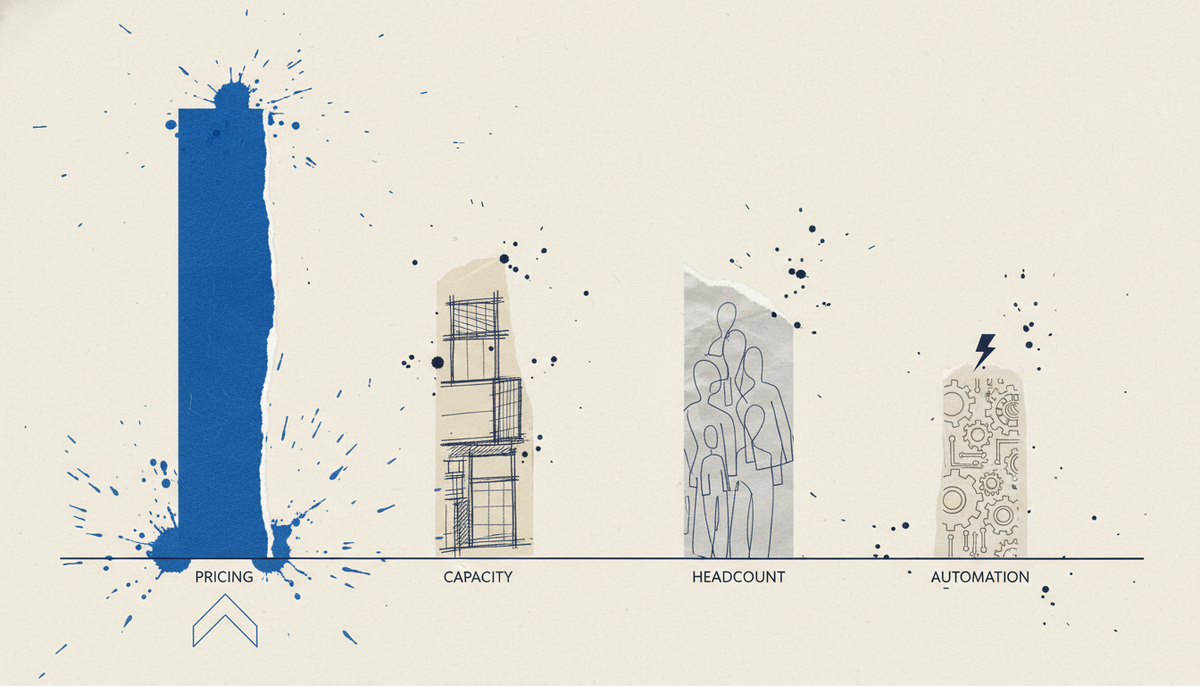
Pricing is the fastest profit lever in a firm. A 5 percent fee increase that holds drops almost entirely to the bottom line. The same 5 percent in additional billable hours costs you capacity, staff stress, and probably some realization.
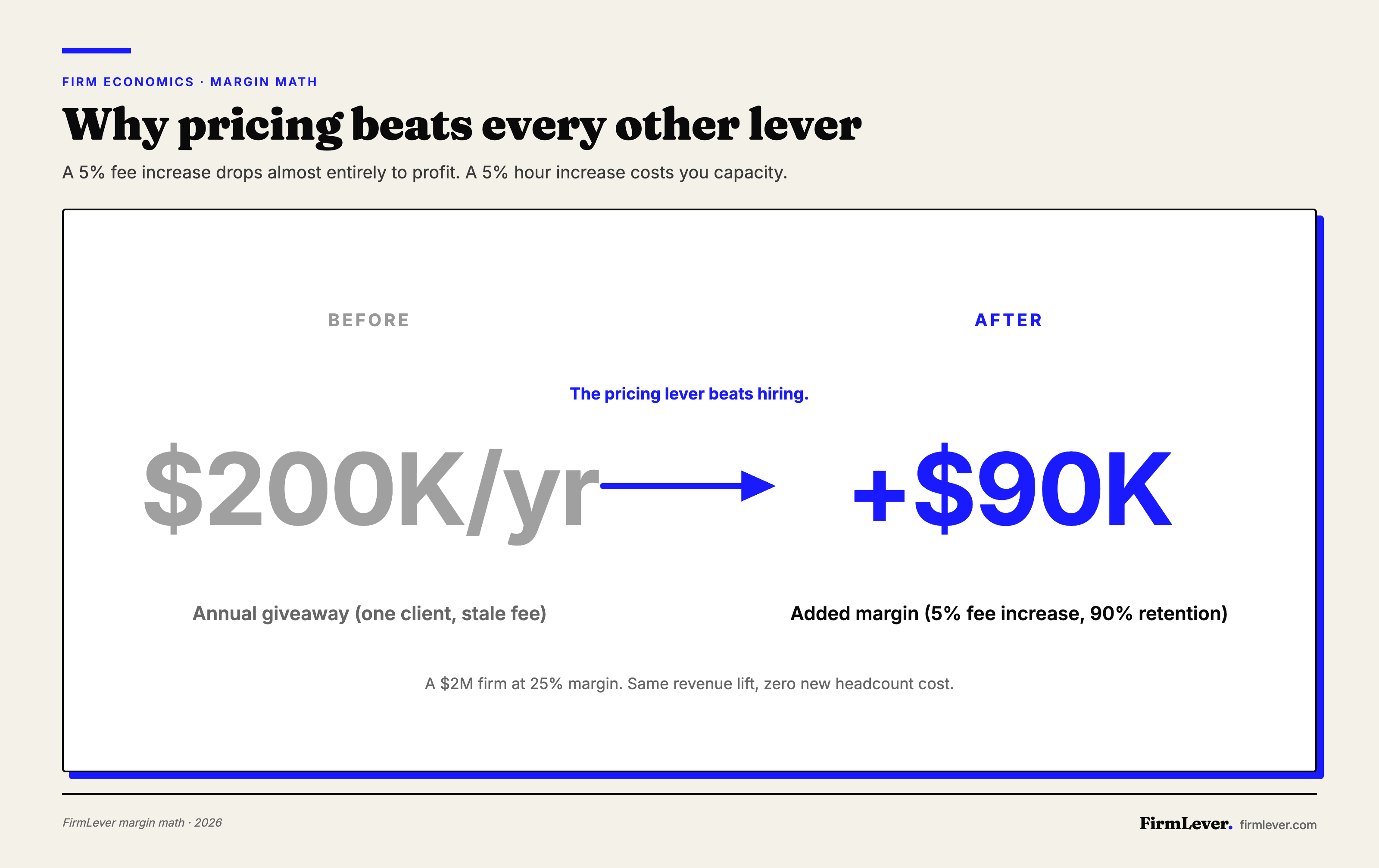
The math on a $2M firm running a 25 percent margin:
- 5 percent fee increase, 90 percent retention. Revenue up roughly $90K. Cost up almost nothing. New margin pushes toward 30 percent.
- 5 percent more billable hours. Revenue up $100K. Cost up in salaries, overtime, or new hires. Margin barely moves.
This is why pricing is the lever I push hardest with members.
Accounting firm margin improvement
Margin is pricing minus delivery cost. Most owners obsess over the cost side. You should own both, with pricing first.
Some specific moves I have watched work in the last twelve months:
- Move the bottom 20 percent of your client list off your book. Sell them, refer them, raise them out, whatever it takes. Your margin on the remaining 80 percent will go up because your team will stop being distracted by low-fee, high-touch clients.
- Charge for onboarding. New client setup is real work. Most firms eat it. Stop.
- Charge for out-of-scope requests in real time, not at year end. The conversation is easier when the work is happening.
- Tier your service offerings. Bronze, silver, gold, whatever you want to call it. Clients self-select up more often than you expect.
- Review your top 20 clients every January. Look at fee versus complexity, fee versus growth, fee versus market. Adjust before tax season, not after.
None of this is exotic. All of it is uncomfortable. That is why most firms do not do it and why the firms that do see margin step up 5 to 10 points within a year.
What this means for the value of your firm
Pricing is not just a profit issue. It is a valuation issue. When a buyer or successor looks at your firm, they look at revenue per client, realization, and margin trajectory. A firm with current pricing, indexed engagement letters, and a clean book trades at a meaningfully higher multiple than the same firm with stale fees.
Team-centric, systematized firms trade at 1.2 to 1.5 times revenue. Partner-dependent firms with messy pricing trade at 0.6 to 0.9 times. The pricing reset is one of the few moves an owner can make in a single year that visibly shifts which tier the firm sits in.
Underpricing is not just costing you margin today. It is costing you the difference between a 0.8x sale and a 1.4x sale on your way out.
Marc
P.S. — FirmLever is where pricing-disciplined firms turn margin discipline into real peer transactions. 316 member firms across 43 states, $644M+ in combined annual revenue, and 108 firm-to-firm connections so far. Members buy, sell, and refer books of business to vetted colleagues, not cold leads, real peers who understand the work. If you have fixed your fees and want to see what is moving in the network, the marketplace is live.