Why Niche Firms Charge Double (And Why Generalists Are About To Feel It)
Firms that pick a lane charge twice what generalists do for the same hours. The gap is about to get wider, and AI is the reason.


Why Niche Firms Charge Double (And Why Generalists Are About To Feel It)
Two firms. Same state. Same 18-person headcount. Same software stack.
One bills $1.4M. The other bills $3.1M.
The $3.1M firm only takes dental practices.
I see this every week inside the FirmLever network. The spread between generalist firms and niche firms is not a rounding error. It is the whole game.
The premium is real and it is not small
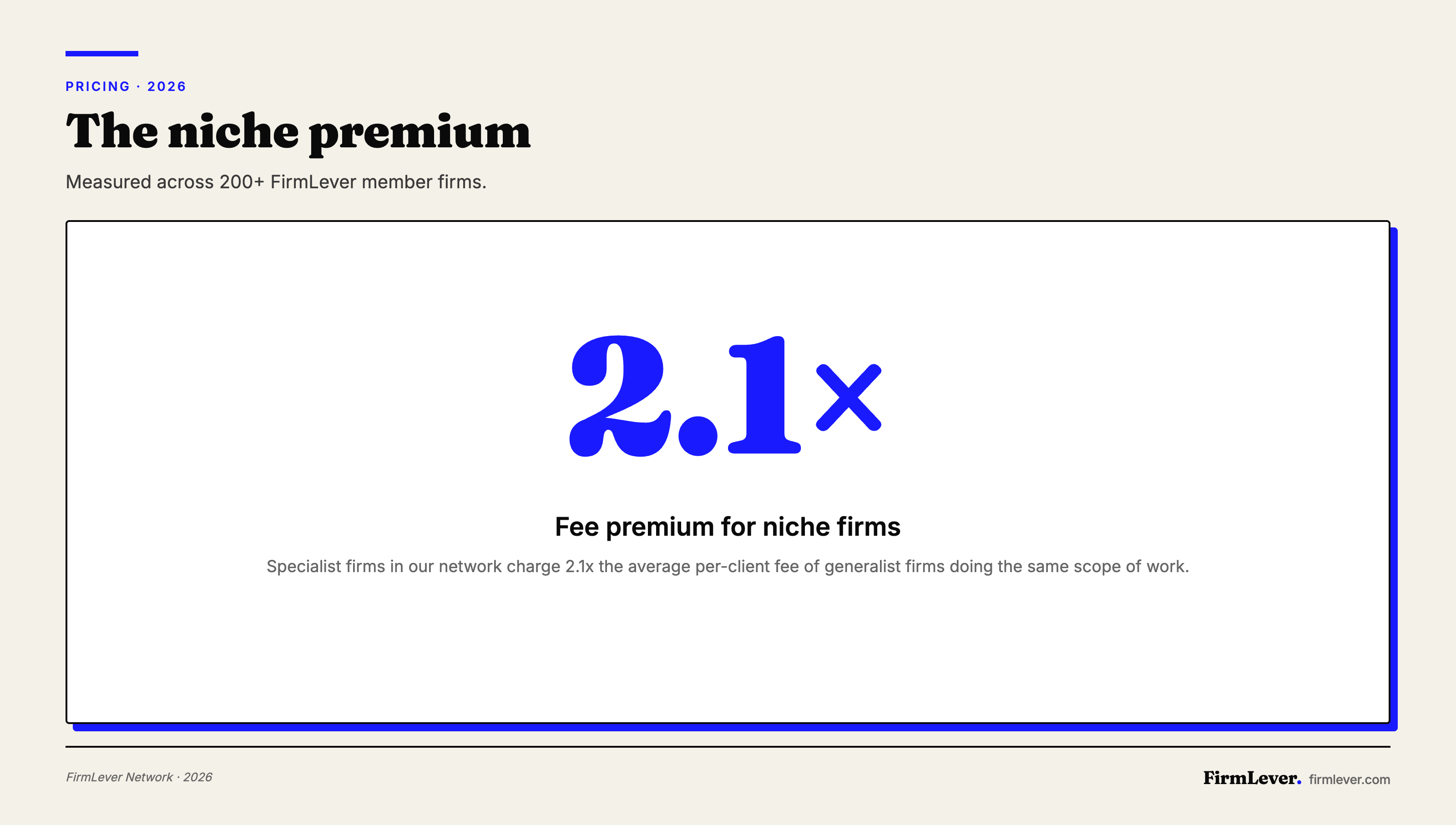
Across our 200+ member firms, the specialists charge roughly twice what the generalists charge for the same scope of work. A 1040 with a Schedule C is a 1040 with a Schedule C. But when it sits inside a package priced for a chiropractor who owns three locations, it bills at $8,800 instead of $4,200.
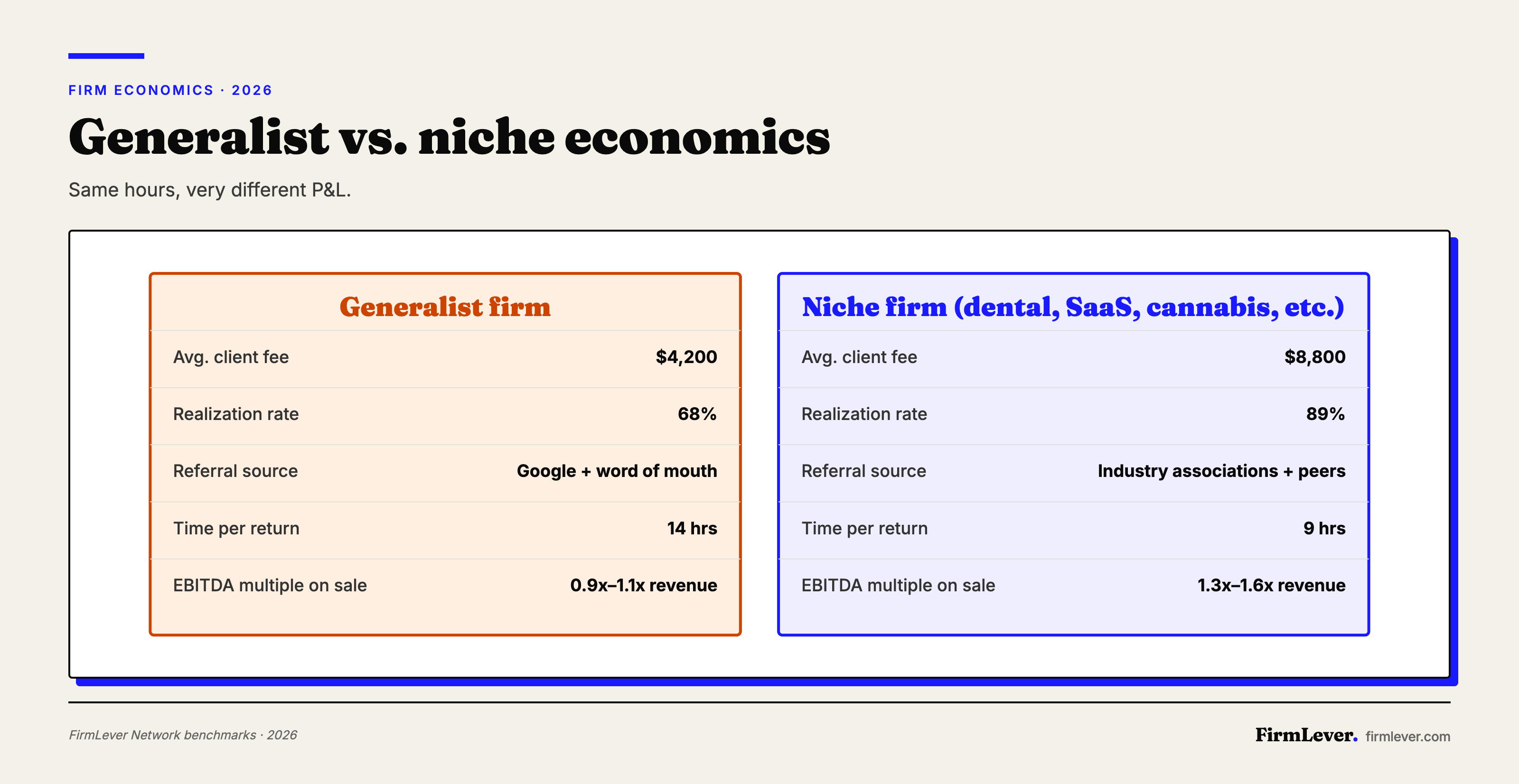
Same hours. Different invoice.
The numbers hold up on the sell side too. Generalist books trade at 0.9x to 1.1x revenue in our deal flow. Niche books trade at 1.3x to 1.6x. On a $2M firm, that is a $600K to $1M difference in what you walk away with.
Why clients actually pay more
Generalists compete on price because clients cannot tell them apart. Every firm website says "trusted advisor." Every firm lists tax, audit, advisory, bookkeeping. The dentist googling CPAs sees fifty identical options and picks the cheapest one within five miles.
Niche firms skip that fight entirely.
When I talk to the owner of a cannabis-focused firm, he does not have competitors. He has a waitlist. His clients found him through three industry podcasts and a 280E webinar he ran two years ago. They are not asking what he charges. They are asking when he can onboard them.
The specialist gets paid for three things:
- Knowing the industry's specific tax code, regulatory quirks, and operating metrics cold
- Being able to benchmark a client against 40 similar businesses instead of guessing
- Saving the client from mistakes that cost more than the fee
That last one is the whole ballgame. A generalist doing a SaaS company's revenue recognition can burn 20 hours learning ASC 606 on the client's dime. The specialist did it last week for three other clients. The client knows this. The client pays for it.
Why AI makes this wider, not narrower
The common take is that AI commoditizes accounting work and everyone's fees collapse. I think that is half right.
AI absolutely commoditizes the generic stuff. Bookkeeping cleanup, basic return prep, standard financial statements. If your firm sells hours of competent accounting work, your hours are about to be worth less. A lot less.
But AI cannot commoditize judgment inside a specific industry context. The software does not know that this dentist's equipment purchase has a specific depreciation angle tied to their PPO mix. It does not know that this SaaS company's deferred revenue is mis-structured because their contracts auto-renew in a weird way. It does not know which R&D credit positions actually survive an audit in the cannabis space.
Specialists are the people feeding context into the machine. Generalists are the people being replaced by the machine.
The firms that will double their fees over the next three years are the ones where the AI does 70% of the work and the human brings the 30% that cannot be automated. That 30% is almost always industry-specific pattern recognition.
If you are a generalist, you are competing with a $20/month tool. If you are a specialist, you are using that tool to serve more clients at higher margins.
How to actually pick a niche
The number one objection I hear: "I can't turn away revenue."
You do not have to. You pick a niche and you start over-serving that niche while everyone else stays a client. Over 18 months, the niche clients become 40% of revenue. Over 36 months, they become 70%. You raise fees on the niche side and let the generalist clients churn naturally or refer them out.
A few filters that actually work:
- An industry you already have 8+ clients in. You know more than you think.
- An industry with a professional association, a trade show, and a podcast. That is your marketing engine.
- An industry with regulatory complexity. Complexity is what you get paid for.
- An industry where the client's revenue per business is north of $1M. Smaller than that and the fees will not support you.
Dental, veterinary, med spas, SaaS, e-commerce above $5M GMV, cannabis, construction, trucking, restaurants with three-plus locations, ag, franchise owners. Any of those work. Pick one where you already have traction.
The referral flip
The best part of running a niche practice is not the fees. It is the referral flow.
Generalists spend money on Google ads and hope. Specialists get referrals from other accountants. When a generalist firm picks up a dental client, they are now looking for a home for that client's complexity because they do not want to learn it. If you are the dental specialist in their network, that client comes to you.
This is a big reason we built FirmLever the way we did. Inside the network, generalist firms are actively posting client blocks and sending service referrals to specialists. The dentist book a generalist does not want to service is worth $180K a year to the right specialist. That trade happens in our network constantly.
If you are a specialist, you should be in the network receiving that flow. If you are a generalist, you should be in the network monetizing clients you cannot serve well anyway.
What to do this quarter
Look at your client list. Count how many clients you have in your top three industries. Pick the one where you have the most traction and the best margins. Build one piece of content for that industry this quarter. One. A benchmark report, a webinar, a guide to a specific tax position.
Put your fees up 15% for new clients in that industry. Watch what happens.
The 2x premium is sitting there waiting. The firms that move now capture it before the AI commoditization wave makes the generalist model unworkable.
Marc
P.S. — If you run a niche practice and want referral flow from generalists who cannot serve their industry-specific clients well, or if you are a generalist sitting on a book that belongs with a specialist, the network is where those trades happen. Get in now.