CFO Services for Small Business Pricing: What to Charge and How to Package It
I've seen the same fractional CFO services quoted at $800 and $8,000 a month. The firms charging more aren't doing more work. They built pricing architecture that signals value before the proposal lands.


I watched two fractional CFOs quote the same client last spring.
Same deliverables. Monthly close review, a rolling 13-week cash forecast, a board deck, and a standing strategy call.
One quoted $800 a month. The other quoted $8,000.
The client picked the $8,000 CFO. Not because the work was ten times better. Because the $8,000 proposal made the buyer feel like they were hiring a financial partner, and the $800 proposal made them feel like they were buying hours.
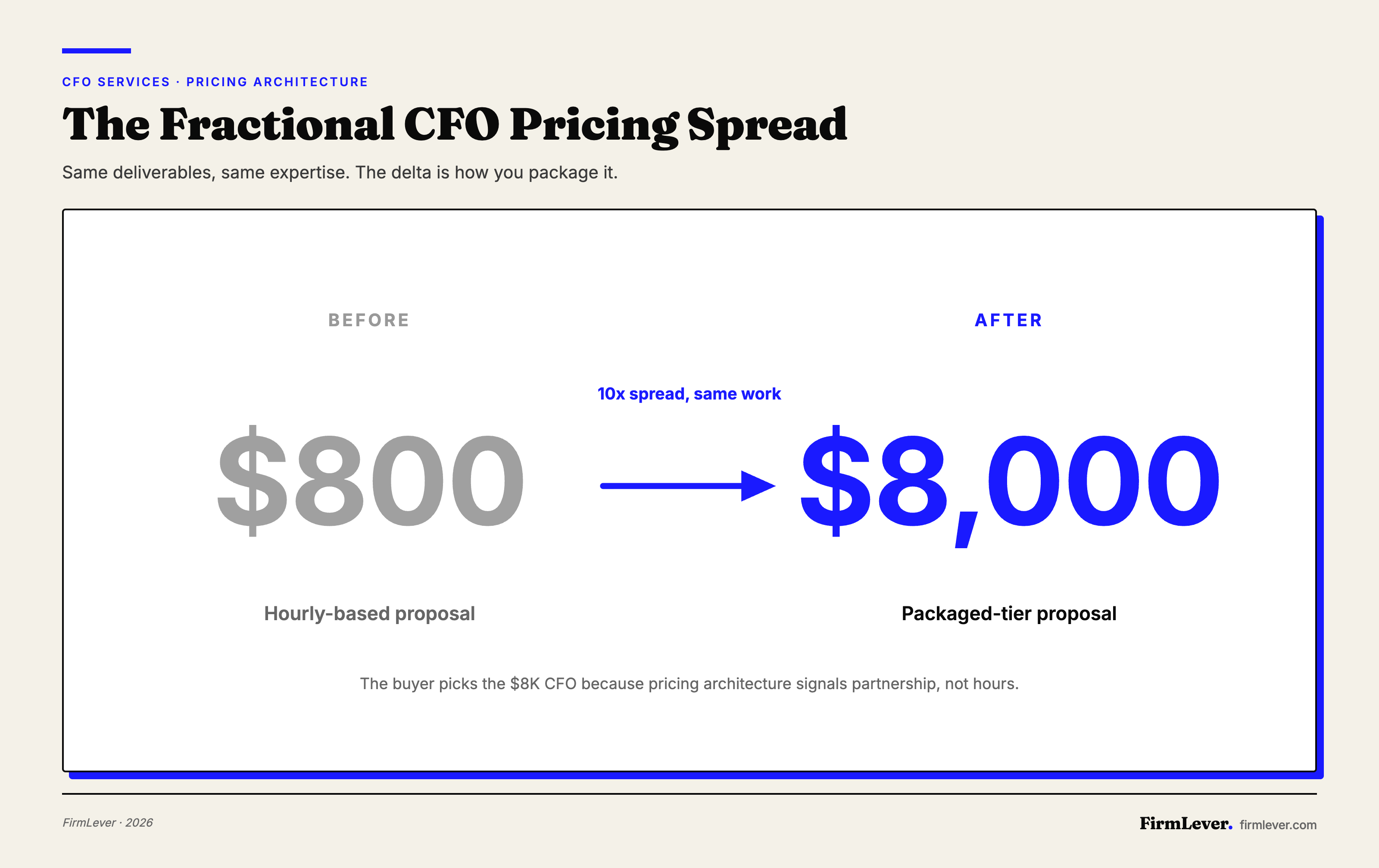
That gap is the whole game. The firms charging more aren't doing more work. They built a pricing architecture that signals value before the proposal lands.
Here's what most fractional CFOs get wrong. They price from their cost. They take their target hourly rate, estimate the hours, and add it up. The client reads that math and negotiates it down. A number built from hours tells the buyer their job is to push back on hours.
The firms winning at the top of the range don't show hours. They show a tier, an outcome, and a price. The client can't negotiate against a package they can't decompose.
Client Advisory Services Pricing
Advisory is where the money is. Bookkeeping is getting cheaper every quarter. Basic compliance is getting cheaper. The judgment work is going the other way, and CFO advisory is judgment work.
Price it like judgment, not like data entry.
A few rules I hold clients to on advisory pricing:
- Never quote advisory by the hour. The second you do, you've told the buyer your time is the product. Your insight is the product. Insight doesn't have an hourly rate.
- Anchor to the client's numbers, not yours. A CFO who helps a $3M business protect two points of margin just created $60,000 of value. A $4,000 monthly fee against that is cheap. Frame the fee next to the outcome and it looks like a bargain.
- Price the relationship, not the deliverable. The board deck isn't the product. The person who reads it and tells them what to do is the product.
Most fractional CFOs undercharge for advisory because they still think like they're billing compliance. They see a monthly retainer and ask "how many hours is that." Wrong question. The right frame is what the decision is worth to the business.
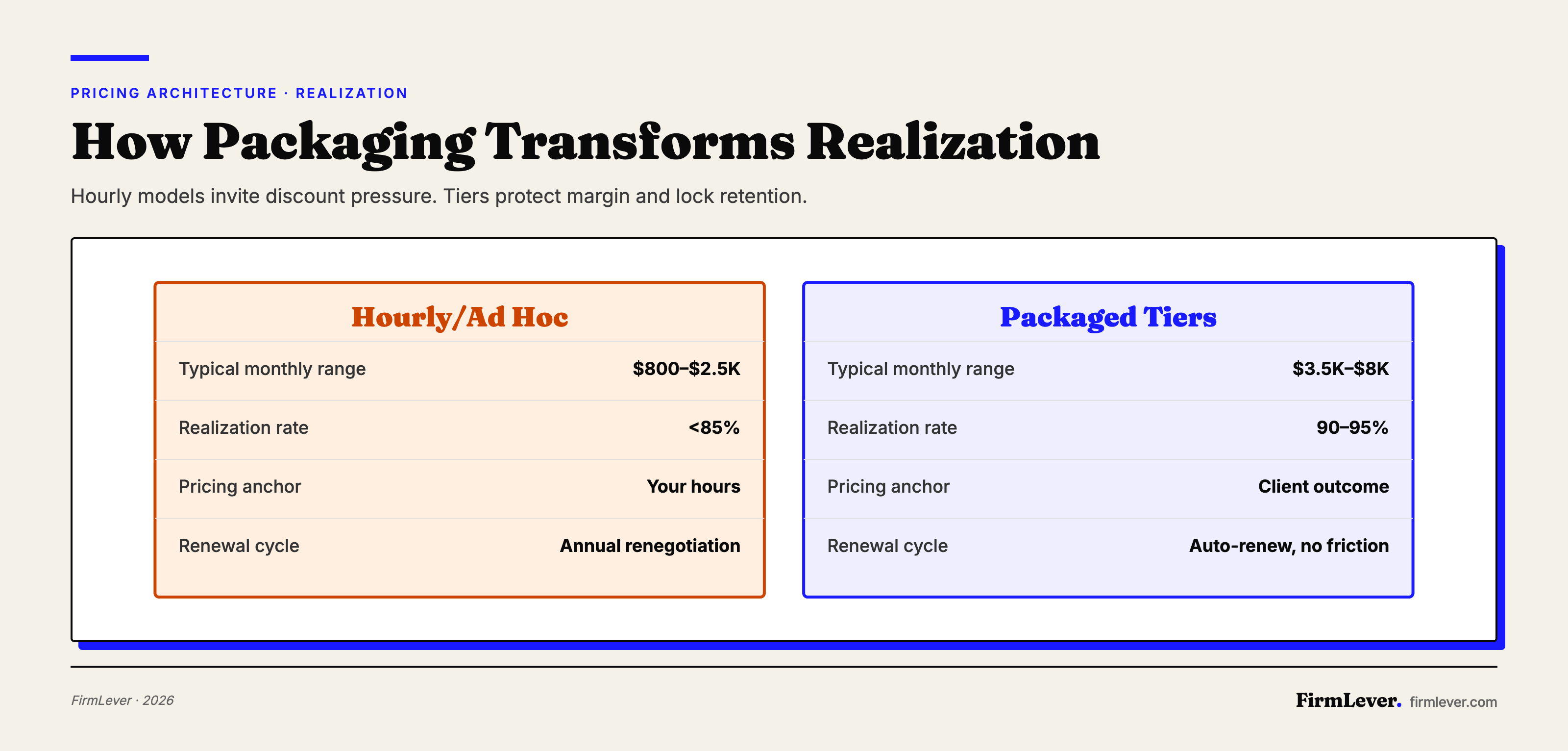
I've seen realization on advisory work sit below 85% at firms that scope it like compliance. Healthy realization is 90 to 95 percent. When you're consistently below that line, it's not a discount problem. It's a packaging problem.
How to Package Accounting Services Into Tiers
Tiers do two things. They let the client self-select, and they make the middle option feel safe.
Three tiers works. Not two, not five. Two feels like a trap. Five is a menu, and menus make people freeze.
Build it like this:
- Foundation. The entry tier. Monthly close, clean financials, a short cash view, one call a month. This exists to make the middle tier look like the obvious choice, not to win most deals.
- Partner. The tier you actually want to sell. Everything in Foundation plus the 13-week cash forecast, KPI dashboard, budget-vs-actual, and a real strategy cadence. This is where most of your clients should land, and where your margin lives.
- Strategic. The premium tier. Everything in Partner plus scenario modeling, fundraising or lending support, board-level presence, and priority access. Some clients never buy this. That's fine. Its job is to make Partner feel reasonable and to catch the buyer who wants the best of everything.
The pricing between tiers matters as much as the tiers. If Foundation is $2,000 and Partner is $2,400, nobody upgrades. The step has to be meaningful. I like Partner priced 60 to 80 percent above Foundation, and Strategic priced 60 to 80 percent above Partner. Those gaps do the selling for you.
One more thing. Put a scope boundary on every tier and price overflow into the next tier up. When a Foundation client keeps asking for Partner-level work, you don't absorb it and quietly tank your realization. You point at the tier. Scope creep becomes a sales trigger.
Accounting Firm Pricing Benchmarks
Numbers give you a floor. Here's what I use as reference points for 2026.
Revenue per employee. A healthy firm runs $175,000 to $225,000 per FTE. If you're at $100,000 to $150,000, you're underperforming, and pricing is usually the first thing I'd look at. A properly packaged CFO practice should be near the top of that band, because advisory carries less labor per dollar than compliance.
Realization. Healthy is 90 to 95 percent. Below 85 percent means your scoping, your pricing, or both are broken. Fractional CFO work should sit at the high end because there's no reason to discount judgment.
Monthly fees. Ad hoc and hourly CFO work tends to land between $800 and $2,500 a month, and stays there because clients renegotiate. Packaged tiers routinely run $3,500 to $8,000 a month for the same underlying expertise. The difference is architecture.
The benchmarks aren't the goal. They're the mirror. If you're under the healthy bands, the fix isn't working more hours. It's charging for the work you already do like it's worth what it's worth.
Because it is. A fractional CFO who helps a business owner make one good decision a quarter is worth far more than the retainer. Your job is to price so the buyer sees that before they see the invoice.
The $800 CFO and the $8,000 CFO did the same work. One built pricing architecture. One built a bill.
Build the architecture.
Marc
P.S. — Not sure if your CFO packages are priced where they should be? Try our new "Do the Work" firm scorecard to see if you're underpriced or working longer owner hours than the rest of the firms in our network. Take the scorecard.