Your Clients Don't Want a Tax Return. They Want to Sleep Again.
The firms winning right now stopped selling deliverables. They sell the problem going away, and the future on the other side of it.


Nobody wakes up wanting a tax return.
Think about the last prospect call you took.
They didn't call because they wanted a 1040. They called because a letter came from the IRS and their stomach dropped. Or their bookkeeper quit. Or they're about to sell the business and they don't know if they'll clear enough to retire. Or they hired a COO and realized they've been guessing at margins for nine years.
The deliverable is the receipt. It's not the product.
The product is the problem going away.
I've sat through hundreds of firm owner conversations on FirmLever. The firms that have repriced in the last 18 months all describe the same shift: they stopped leading with what they produce and started leading with what stops happening once the client signs.
The two price ceilings
When you sell a tax return, the prospect has a number in their head. They got it from their last preparer, their brother-in-law, or a Google search. That number is your ceiling. You can fight it, justify around it, throw in a "complexity surcharge". It doesn't move much.
When you sell the IRS letter going away, the ceiling is different.
It's whatever the problem is costing the client: the sleepless nights, the fight with their spouse, the deal stalled because diligence can't get clean financials. That ceiling is typically 3 to 10 times higher than the form-cost ceiling.
Same work. Same hours. Different ceiling.
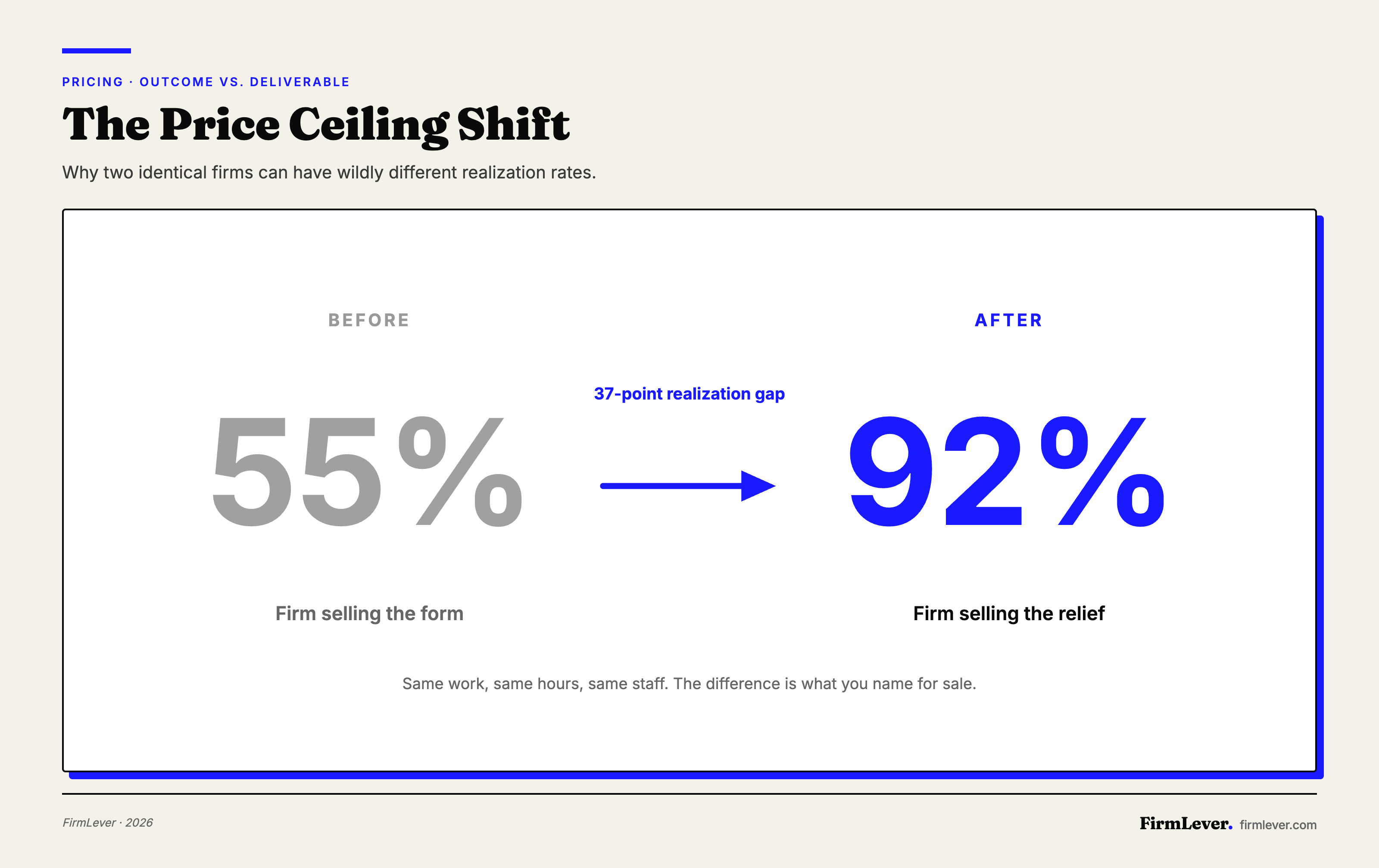
This is why two firms with identical staff and identical software can run a 55% realization rate and a 92% realization rate.
One is selling the form. The other is selling the relief.
What prospects actually say when you listen
Listen to the words prospects use on a first call. They almost never say "I need a financial statement." They say things like:
- "I have no idea if we're actually making money."
- "My last accountant disappeared in March and never picked up the phone."
- "The bank wants something by Friday and I'm panicking."
- "I want to sell in three years and I don't know if I'm ready."
- "My husband and I keep fighting about the books."
Every one of those is a problem statement. Not a deliverable request.
The firms that win these prospects mirror the language back. "So what you're describing is, you want to stop panicking every time the bank calls. Let's talk about what that looks like." The firms that lose them say, "Sure, we can do a compilation for $2,400."
Both firms could do the work. Only one named what they're actually selling.
The "better future" half is where the money is
Relief is half the sale. The other half is the future on the other side of it.
A business owner doesn't just want the IRS letter to stop. They want to look at their phone in 18 months and not feel that spike of dread when an unknown number calls.
They want to walk into the bank meeting with a folder and feel like they know what they're doing. They want to be able to tell their kid that the business is worth something.
That future is what they're paying for. The return is the proof it happened.
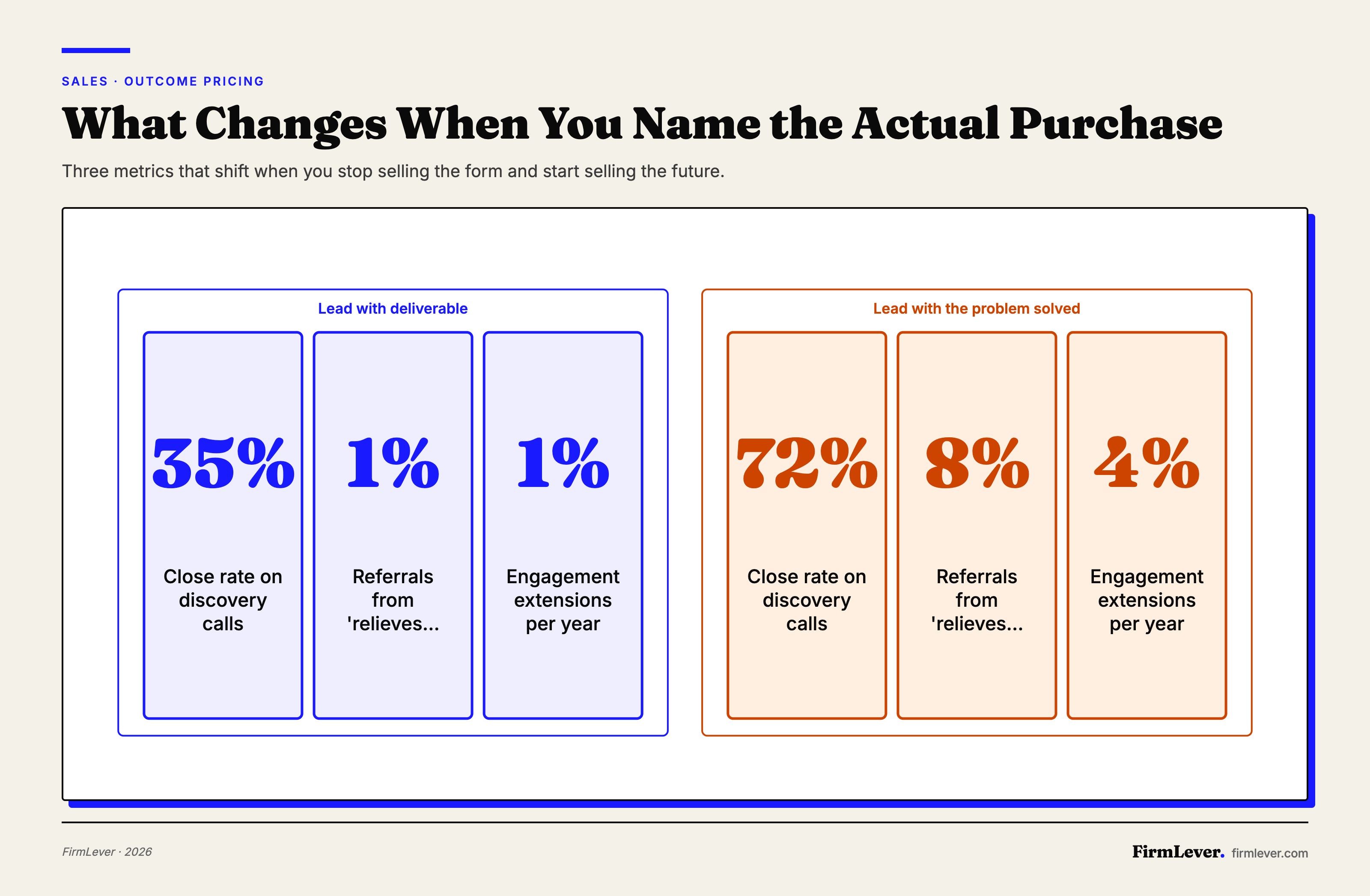
When you sell the future, three things change:
- Price stops being the conversation. Outcome becomes the conversation.
- The engagement gets longer. You're not selling one form; you're selling a state of mind that needs maintenance.
- Referrals get better. People don't refer their accountant for being accurate. They refer them for "I don't worry about this anymore." That message travels.
How to retool one conversation this week
You don't have to rebuild your firm. Try this on the next discovery call.
Ask one question: "What made you finally pick up the phone today?" Then shut up. Whatever they say next is the actual product. Write it down.
In the proposal, lead with their sentence. Not your service list. Their sentence. "You said you want to stop dreading payroll Fridays. Here's what that looks like 90 days from now." Then the scope. Then the price.
Do that ten times and watch your close rate and average engagement fee move. The work doesn't change. The thing you named for sale does.
Your prospects are not buying tax returns. They never were. They're buying the version of themselves that doesn't have to think about tax returns.
Sell them that.
Marc
P.S. — Try our new "Do the Work" firm scorecard to see if you are underpriced or working longer owner hours than the rest of the firms in our network.