Selling Your MSP Accounting Practice in 2026: The Specialist Premium
How IT and MSP accounting firms command 6x-9x EBITDA in 2026, plus what buyers actually pay for when they acquire a specialized book.


For years, I've watched generalist firms struggle to value specialized practices correctly. The 2026 data shows a clear bifurcation: generalist firms trade at standard multiples, while firms with deep vertical expertise in IT and MSP accounting are commanding a "specialist premium." Your clients' complexity demands advisory work that's hard to replicate. The $7B merger between Baker Tilly and Moss Adams in April 2025 signals appetite for scale and specialized capabilities. The question is no longer if you can sell IT services MSP accounting practice assets for a profit, but how to structure the deal to capture the value of your intellectual property.
The 2026 Valuation Landscape: Why IT/MSP Niches Command a Premium
To understand what your firm is worth, look at your client base. IT Services and Consulting firms are trading at median EV/EBITDA multiples of 13.0x in the US and 10.2x in Europe. These multiples affect you directly. High client valuations mean capital, acquisition growth, and demand for sophisticated financial guidance. Your firm becomes a strategic asset to any buyer entering the technology vertical.
Private equity involvement is increasing, creating competition for "platform opportunities." Accounting firms that serve as a nucleus for rolling up other tech-focused practices are prime targets. If your firm has mastered advisory for MSPs, you're a prime acquisition candidate.
Comparative Market Multiples (Client Sector)
Understanding the sector you serve is critical for negotiation. Here's a snapshot of current multiples in the public IT Services & Consulting sector, which drives demand for specialized accounting services:
| Region | Median EV/EBITDA Multiple | Market Sentiment |
|---|---|---|
| United States | 13.0x | Strong growth, driven by AI and Security |
| Europe | 10.2x | Steady, focused on consolidation |
| India | 15.6x | High growth, aggressive outsourcing expansion |
| Japan | 10.3x | Stable, focused on automation |
For a deeper dive into how these factors influence firm valuation, see The Firmlever Weekly Roundup: Issue #31, which covers the correlation between client-sector health and accounting firm multiples.
The DNA of a Specialized Firm: What Buyers Are Really Buying
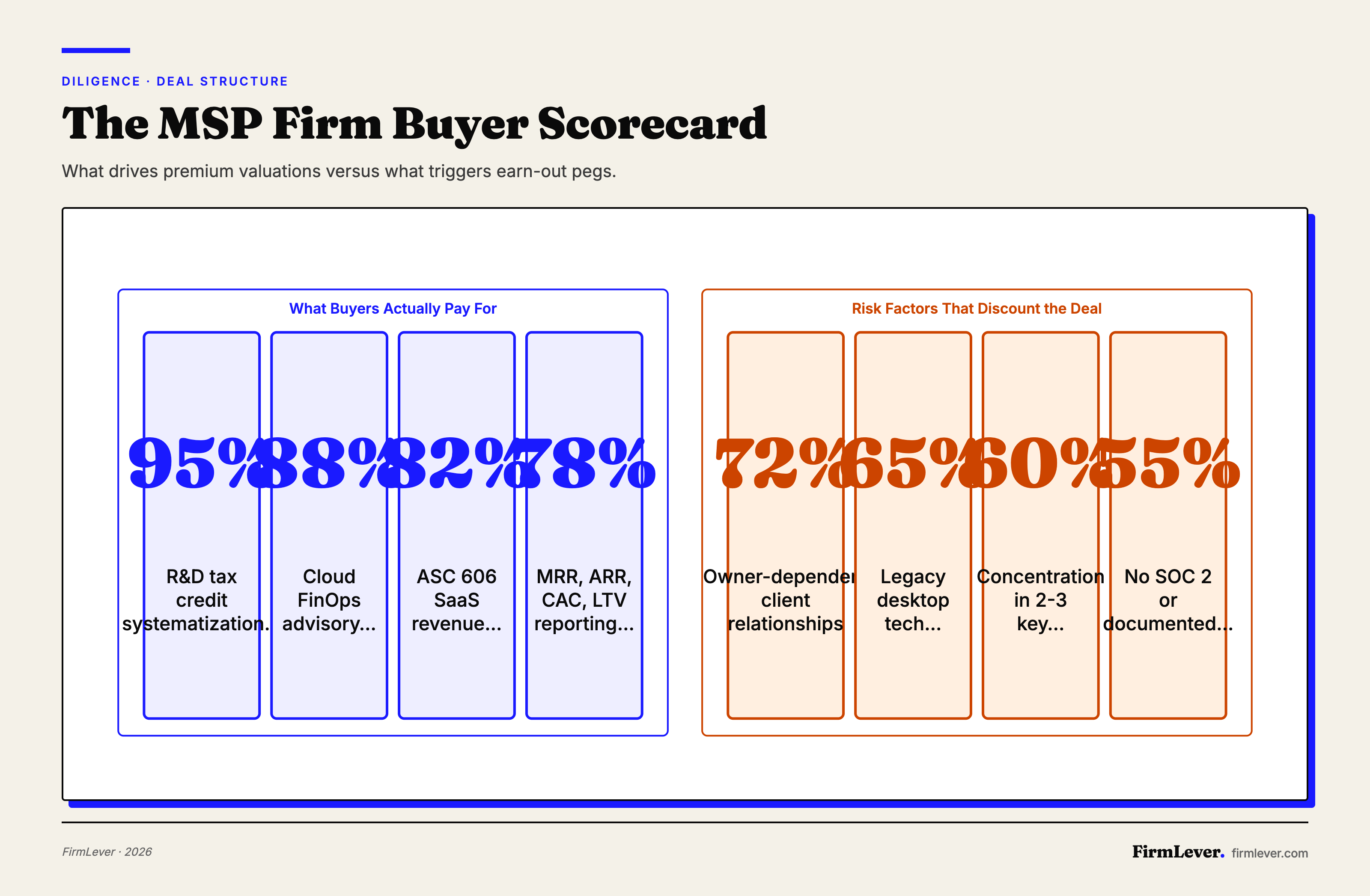
Generalist buyers see tax returns and audits. Buyers looking at IT and MSP specialists see defensible intellectual property. In 2026, your value is defined by your ability to handle complex, niche-specific financial challenges. If you're planning to sell, document and highlight your proficiency in these areas.
1. Deep Expertise in R&D Tax Credits (Section 41 & Section 174)
Many generalist firms leave money on the table with R&D credits for tech clients. Your firm's ability to navigate Section 41 research credits and Section 174 amortization requirements is a major value driver. Buyers want firms that have systematized the R&D study process and have frameworks for identifying qualified research expenses in software development, cloud architecture, and cybersecurity testing. This expertise creates a moat around your client base. Clients are reluctant to leave because a generalist might miss substantial tax savings.
2. Cloud FinOps and Spend Management
In 2026, accounting for IT firms isn't just historical cost tracking. It's active spend management. Demand for "FinOps as a Service" has surged. If your practice advises clients on optimizing AWS, Azure, or GCP spend, you've elevated yourself from compliance vendor to strategic partner. Buyers pay premiums for this because it represents high-margin advisory revenue. Helping clients tag cloud resources for cost allocation to specific customers or projects shows the level of granularity that separates modern MSP accounting from the traditional kind.
3. SaaS Revenue Recognition (ASC 606)
The shift to subscription models is complete. Nearly every MSP you serve has recurring revenue. Mastery of ASC 606 (Revenue from Contracts with Customers) is required. Buyers will scrutinize your work papers to ensure correct revenue recognition over service periods, handling of distinct performance obligations, and contract modification management. If you've built proprietary spreadsheets or software integrations that automate this, your valuation increases significantly.
4. KPI Advisory: The Language of MSPs
Your clients run on metrics like Monthly Recurring Revenue (MRR), Annual Recurring Revenue (ARR), Churn Rate, Customer Acquisition Cost (CAC), and Lifetime Value (LTV). An accounting firm producing only a P&L has low value to an MSP. One that translates financial data into these operational metrics is indispensable.
When presenting to buyers, showcase your monthly reporting packages. Do they include dashboards for these metrics? For a comprehensive list of relevant metrics, see The Ultimate Glossary of Accounting Firm Metrics, KPIs & Valuation Terms (2026 Edition).
Navigating the Sale: Tech Stacks and AI Integration
The $500M+ investment by Crete Professionals Alliance into AI-powered accounting firm roll-ups is a wake-up call. Buyers in 2026 are obsessed with efficiency. They're buying your revenue and your workflow.
If your firm serves IT clients, the buyer expects your internal tech stack to be solid. You can't serve a cutting-edge Managed Security Service Provider using desktop-based legacy accounting software and paper files.
- Automation First: Do you use optical character recognition for AP? Do you have automated bank feeds and reconciliation rules?
- AI Implementation: Are you using AI for preliminary contract reviews or anomaly detection in general ledgers?
- Security Standards: Because you handle data for IT security firms, your own cybersecurity posture matters. SOC 2 compliance or NIST framework adherence can smooth due diligence significantly.
Buyers increasingly look for firms with "productized" services. Your delivery of FinOps or fractional CFO services should follow standardized processes that create predictable margins. For more on how tech stacks influence deal terms, see The Complete Guide to Cloud Accounting Firm Acquisition.
Structuring the Deal: What to Expect in 2026
With valuation multiples holding strong, deal structure has become the primary negotiation point. In the MSP niche, client retention is high but relationships are often personal. The owner of an MSP trusts you because you solved a complex equity compensation issue or a software capitalization question.
Buyers are structuring deals to protect against churn during transition. Here's what we're seeing:
The "Retention Peg"
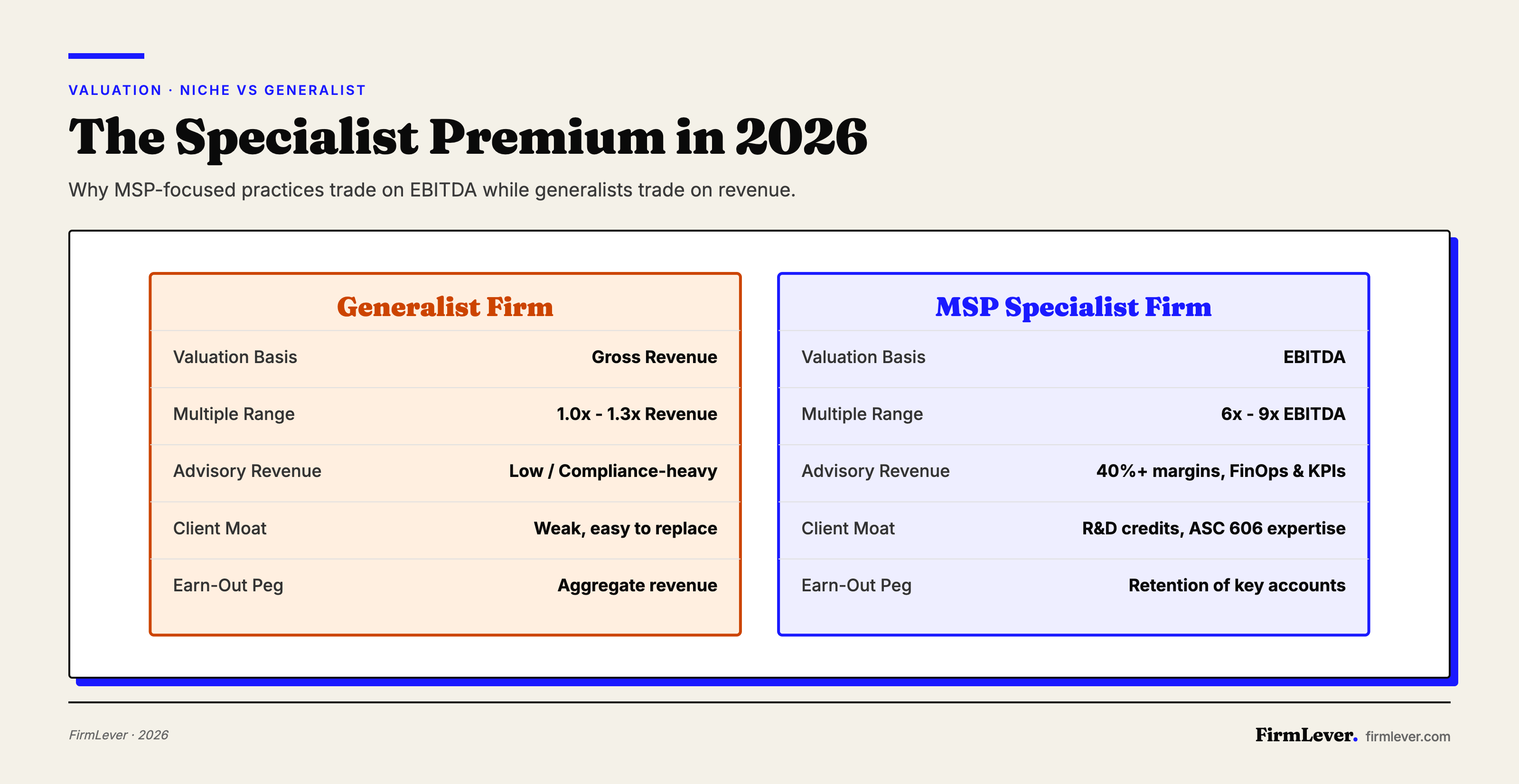
Most 2026 deals involve a substantial earn-out period, typically 2 to 3 years. For niche firms, the earn-out is often pegged to retention of specific high-value clients rather than aggregate revenue. IT clients can be large, paying $50k–$100k annually in fees. Losing just two or three key accounts tanks profitability.
Valuation Methodologies
Traditional firms are valued on Gross Revenue multiples (1.0x–1.3x). Highly specialized MSP accounting firms are increasingly valued on EBITDA, similar to their clients. We're seeing multiples of 6x to 9x EBITDA for firms with strong margins (40%+) and low owner-dependence. For a realistic sense of where your numbers fall, read The Complete Guide to Valuation of Accounting Practice: What Is Your Firm Really Worth in 2026?.
Preparing Your Client Base for the Transition
Your clients are tech-savvy and notice service disruption immediately. An MSP owner will see it if the quality of their monthly SaaS metrics report drops.
Documentation is key to a smooth transition. Before going to market, ensure every client has a "Standard Operating Procedure" (SOP) for their account. Detail their tech stack, revenue recognition rules, and preferred communication channels.
Also "institutionalize" the relationships. If you're the only person who understands how Client X capitalizes software development costs, that's a risk. Start involving managers or senior staff in high-level advisory meetings 12–18 months before you plan to sell.
Frequently Asked Questions
1. How does specializing in MSP clients affect my firm's multiple compared to a generalist firm?
Specialization increases your multiple. Buyers view niche expertise as a competitive advantage that enables premium pricing and higher retention. A firm with proven MSP accounting expertise (ASC 606, FinOps, etc.) commands a 10–20% premium over generalist firms because of high barriers to entry and sticky advisory services.
2. Should I divest non-IT clients before selling?
Not necessarily, but segment them. If 80% of revenue comes from IT/MSP and 20% from dentists and restaurants, a strategic buyer might only want the IT portion. Many buyers take the whole portfolio and spin off non-core assets later. Present financials with clear segmentation so buyers can value the high-growth IT vertical separately.
3. How important is my firm's location in 2026?
For IT and MSP accounting, location is virtually irrelevant. Your clients are remote or distributed, and they expect the same. A fully remote firm is often more attractive because it implies lower overhead and a wider talent pool. The absence of a physical lease is a plus in modern M&A transactions.
4. What specific risks do buyers look for in MSP accounting firms?
Buyers look for "concentration risk" (one MSP client as 15% of revenue?) and "competency risk" (does staff actually understand software accounting, or just the owner?). They also scrutinize liability exposure on R&D tax credit claims. Aggressive Section 41 claims without proper documentation will surface in due diligence.
5. Can I sell to a private equity firm directly?
Usually only if you've achieved significant scale (typically $5M+ revenue). Smaller specialized firms are prime targets for "tuck-in" acquisitions by larger PE-backed platforms. You probably won't sell to the PE firm directly, but to a firm owned by one. See The Ultimate Accounting Firm Metrics & Valuation FAQ: 150+ Questions Answered (2026 Edition) for more on these mechanics.
6. How do I prove the value of my "Advisory" revenue?
Advisory revenue is valuable, but buyers often view it as one-time. Prove its recurring nature. Structure advisory services (vCFO, FinOps) as monthly subscriptions rather than hourly billing. Show churn rates specifically for advisory packages to demonstrate these are long-term relationships, not one-off projects.
7. What is the role of AI in the valuation of my firm?
AI is a multiplier. Demonstrate higher revenue per employee due to AI-driven workflows, and your EBITDA margins rise, driving higher valuation. Buyers pay for the system that generates profit. An AI-enabled system is more scalable and future-proof.
Conclusion
Selling an MSP-focused accounting firm in 2026 is a real opportunity. You're in a vertical where clients are growing, capital is flowing, and complexity justifies high fees. Focus on specific value drivers—SaaS metrics, R&D credit expertise, Cloud FinOps—to differentiate from generalist practices.
The market is consolidating. The "specialist premium" is real. Whether you exit in six months or six years, today's work documenting IP and solidifying recurring advisory revenue defines your ultimate payout. Technology and accounting are converging and creating wealth. Position yourself to capture your share.
To stay current on valuation trends, buyer strategies, and the evolving accounting firm M&A landscape, subscribe to our blog for data-driven insights to navigate your exit with confidence.