The 2026 AI Moves Small Firms Are Actually Making Money With
Forget the keynote demos. Here's what partners at $500K to $5M firms are actually doing with AI right now to claw back hours and protect margin.

Every AI keynote I sit through shows the same thing.
A robot doing a tax return in 90 seconds. The room claps. Nobody goes back to the office and does anything different on Monday.
The real story is more discrete, and I've been talking to FirmLever members for months about what they're actually using AI for. Not the moonshot pitches. The boring stuff that's pulling 8 to 12 hours a week off a partner's plate.
The stuff that's letting a 6-person firm punch above its weight against a 30-person firm down the road.
None of it is glamorous. All of it is working.
The Real Math
Here's what I keep hearing. Firms running disciplined AI workflows aren't replacing staff. They're replacing the slow, dumb hours that used to bury staff. The partner who was reviewing returns until 9pm in March is now done at 6pm. That shifts things at home in ways no bonus ever could.
A $1.4M firm in Ohio told me they cut review time on individual returns by roughly 40%. They didn't lay anyone off. They took on 60 more 1040s with the same team and stopped quoting March nights to spouses.
A $2.8M firm in Texas told me they used AI document parsing to kill their data entry function entirely. The person who used to do that work is now their client onboarding lead. Same salary. Way more revenue produced.
The pattern isn't "AI replaces accountant." It's more like "AI eats the worst part of every accountant's day."
The Use Cases Actually Moving The Needle
Here's what I'm seeing work. None of this requires a six-figure tech budget. Most of it runs on tools members are already paying for.
Client email triage. Partners getting 80+ emails a day are routing them through AI assistants that draft replies, flag urgent items, and auto-summarize threads before the partner opens them. One member told me he reclaimed his first two hours of every morning. He used to spend them sorting inbox. Now he spends them on advisory calls.
Meeting prep and recap. AI listens to client meetings, drafts the recap, pulls action items, and generates the follow-up email. A fractional CFO I know runs eight client meetings a day. He used to lose his Fridays to writing recaps. Now Friday is sales.
First-draft engagement letters and SOWs. Members are feeding past engagements into AI and getting tailored first drafts in 90 seconds. The partner still reviews. But the staring-at-blank-page tax is gone.
Bookkeeping anomaly detection. Instead of staff scrolling through GL detail looking for weird transactions, AI flags the 12 entries that don't match historical patterns. Review time on monthly closes is cut roughly in half.
Research and citation pulling. Tax questions that used to mean an hour in BNA are getting first-pass answers in two minutes. Staff still verify. But the discovery phase collapsed.
Workflow status updates. AI pulls together where every client engagement stands and writes the Monday morning team brief. Operations managers used to spend three hours on that. Now it's 15 minutes of editing.
Niche content and thought leadership. Smaller firms are competing for niche clients (dentists, breweries, e-commerce) by publishing weekly content. AI drafts it. Partner edits. A firm I work with picked up four dental practices in six months from one blog series they wouldn't have had time to write before.
The thread across all of these: AI doesn't do the partner's job. AI does the work that gets in the way of the partner's job.
Where The Money Actually Moves
The interesting move isn't time savings. The interesting move is what firms do with the saved time.
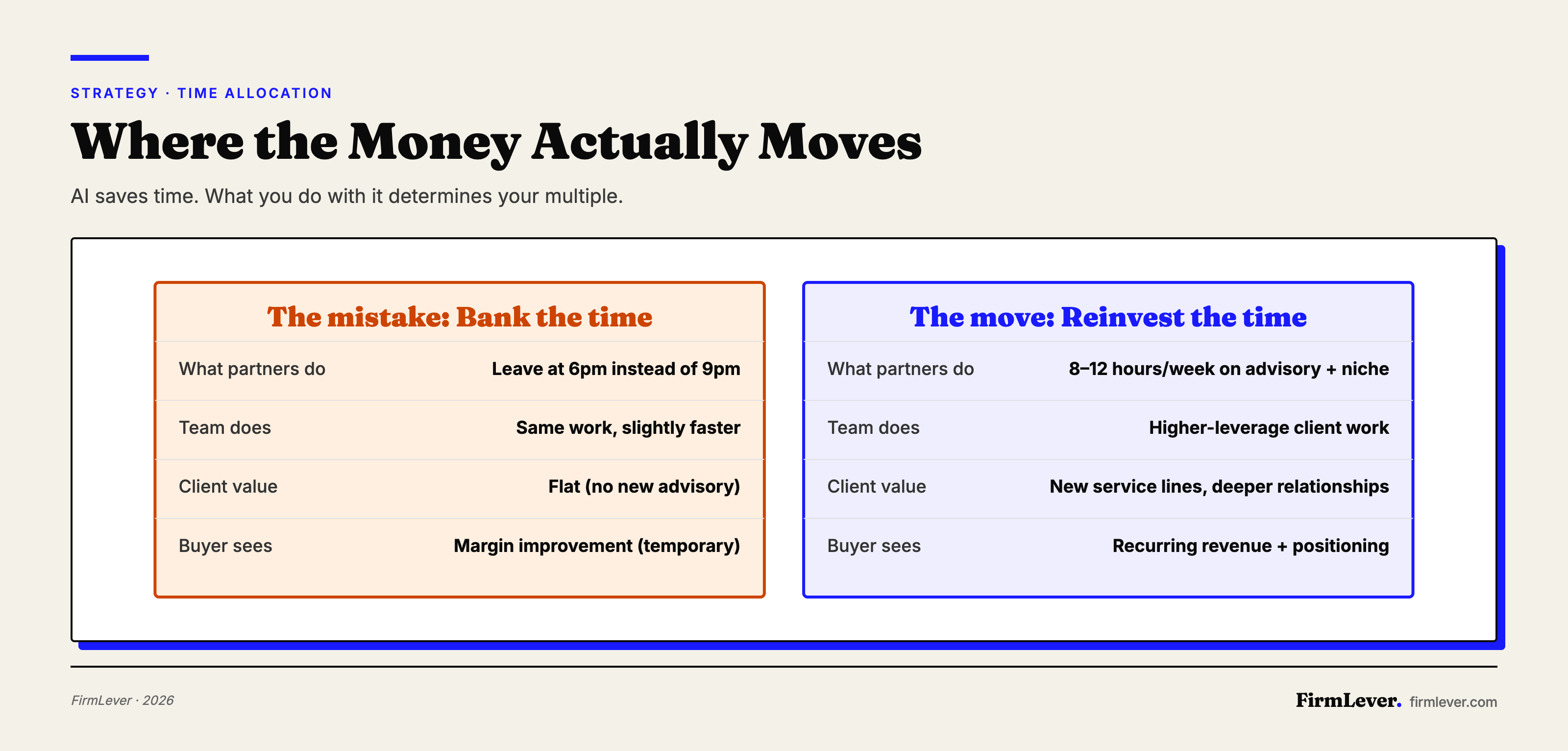
The smart ones are reinvesting every reclaimed hour into advisory, niche specialization, and owner relationships. Cloud-native firms with this discipline are already commanding 30–50% higher multiples than non-cloud peers. When buyers look at a firm in 2026, they're not impressed that you use AI. Everyone uses AI. They're impressed by what your team became because you use AI.
Don't bank the hours as profit. Spend them on positioning.
The Three Mistakes I Keep Seeing
A few patterns to avoid. I've watched these break firms.
- Buying tools instead of changing workflows. A subscription doesn't save time. A documented process that uses the subscription saves time. Firms with five AI tools and no process documentation are worse off than firms with one tool and a tight playbook.
- Letting AI touch client data without a policy. I've seen partners paste client SSNs into public chatbots. That's a malpractice claim waiting to happen. Get a policy in writing. Use enterprise tools with data agreements. Train your team.
- Confusing speed with judgment. AI gives you a first draft in seconds. That doesn't mean the answer is right. Realization rates dropping below 85% are often a pricing problem. Realization rates dropping because staff are sending AI output without reviewing it? That's an existential problem.
What This Means For Your Firm Value
The firms that get this right in 2026 are going to look very different to buyers and referral partners in 2027.
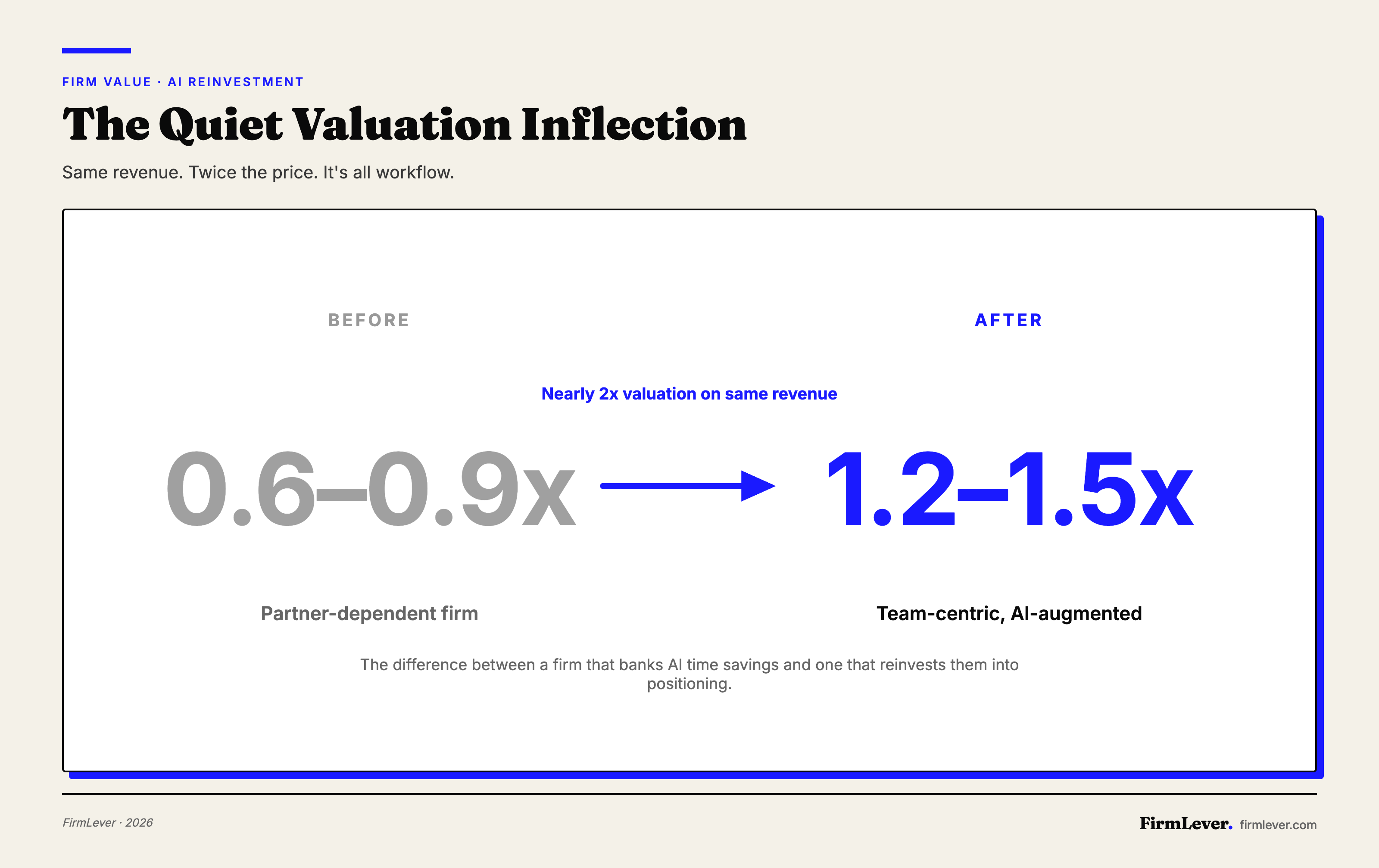
A partner-dependent firm that runs everything through one rainmaker is worth 0.6 to 0.9x revenue. A team-centric, systematized firm with documented AI-augmented workflows is worth 1.2 to 1.5x. That's not a typo. Same revenue, same client base, valued nearly twice as high because of how the work gets done.
The firms putting AI into the bones of their operation aren't just saving hours. They're building something that sells. The ones that don't will wake up in 2028 and find that the best clients have moved to specialists, the best buyers are passing on partner-dependent shops, and the time they thought they were saving by "waiting to see how AI shakes out" cost them about half their valuation.
Pick a use case this quarter. Document it. Train the team. Then add the next one.
Marc
P.S. — Try our new firm scorecard to see if you are underpriced or working longer owner hours than the rest of the firms in our network.