600 advisors complained about CPA referrals. The CPAs answered them.
A BlackRock director's post pulled 75 comments, mostly from CPAs explaining why RIA referral relationships break. None of them named the third path that quietly erases the whole problem.


Last week Cullen Roberts, the Director of Advisor Engagement at BlackRock, posted about a Minneapolis event with about 600 financial advisors. The thing most of them wanted to talk about was their broken referral relationships with CPAs.
The complaints are familiar. We send a ton of clients to CPAs and get nothing back. Our clients really want forward-looking tax advice, not just compliance work. I'm done trying.
Then the comments came in, and most of them were from CPAs answering back.
Brad Wooten put it cleanest: "You can find a hundred good advisors in a week and you can't find a hundred good tax pros if you spent a year searching. Which is probably why the referrals tend to only go in one direction."
Brad's right, and he's also a member of the FirmLever Network — an invite-only platform for accounting firm owners to refer client work directly to each other. So is Sam Ash, CPA, CFP®, who jumped into the thread with the structural reason this dynamic exists. CFPs refer clients to CPAs because tax work is required by law. CPAs referring clients to CFPs are recommending something the client should buy but isn't required to. That's why the volume goes one way no matter how many CPA-advisor lunches happen.
Read further down and the same picture comes back from every angle. Nancy McClelland describes the typical advisor pitch as a meat market where her clients get treated like prey. Robin Rudisill writes off advisors who walk in wanting her client list rather than a relationship. Kristin Delfau notes that most advisors drop client money into models and coast. Brenda Cannon points out that CPAs are surviving Jan through April, not networking with anyone.
It's the most honest read on this dynamic I've seen on LinkedIn in a long time. The solution that fixes the whole thing is the one almost no one named directly.
What CPAs are quietly already doing
Say a tax-only CPA. A client comes in with $5M from a business exit and they need wealth management. The CPA doesn't do that.
Option 1: Refer the client to an external RIA. The client now has three professional relationships instead of one. The CPA has to vet someone they don't know well, hope the chemistry works, and trust that the client comes back. That RIA will walk in looking like exactly the kind of salesperson Nancy and Robin already dismissed. If the fit is bad, the CPA takes the blame and loses the client everywhere.
Option 2: Refer to another accounting firm that runs an integrated wealth practice. The receiver has the same regulatory frame, the same firm DNA, and one team handling tax, planning, and investments under one roof. The client has one professional relationship instead of three. The referring CPA hands off to a peer, not a salesperson.
This is what 158 firms on the FirmLever Network are already doing. They send wealth opportunities to a smaller pool of accounting firms running wealth in-house, and the receiving pool is the scarce side of that trade.
Shawn M.F. came closest to naming it in the thread when he plugged HBKS Wealth and HBK CPAs. The integrated CPA-plus-wealth firm is what the conversation was actually about. He framed it as a single firm with both arms under one roof, and we're building that as a network.
Why this works structurally
The integrated path solves every gripe in the thread.
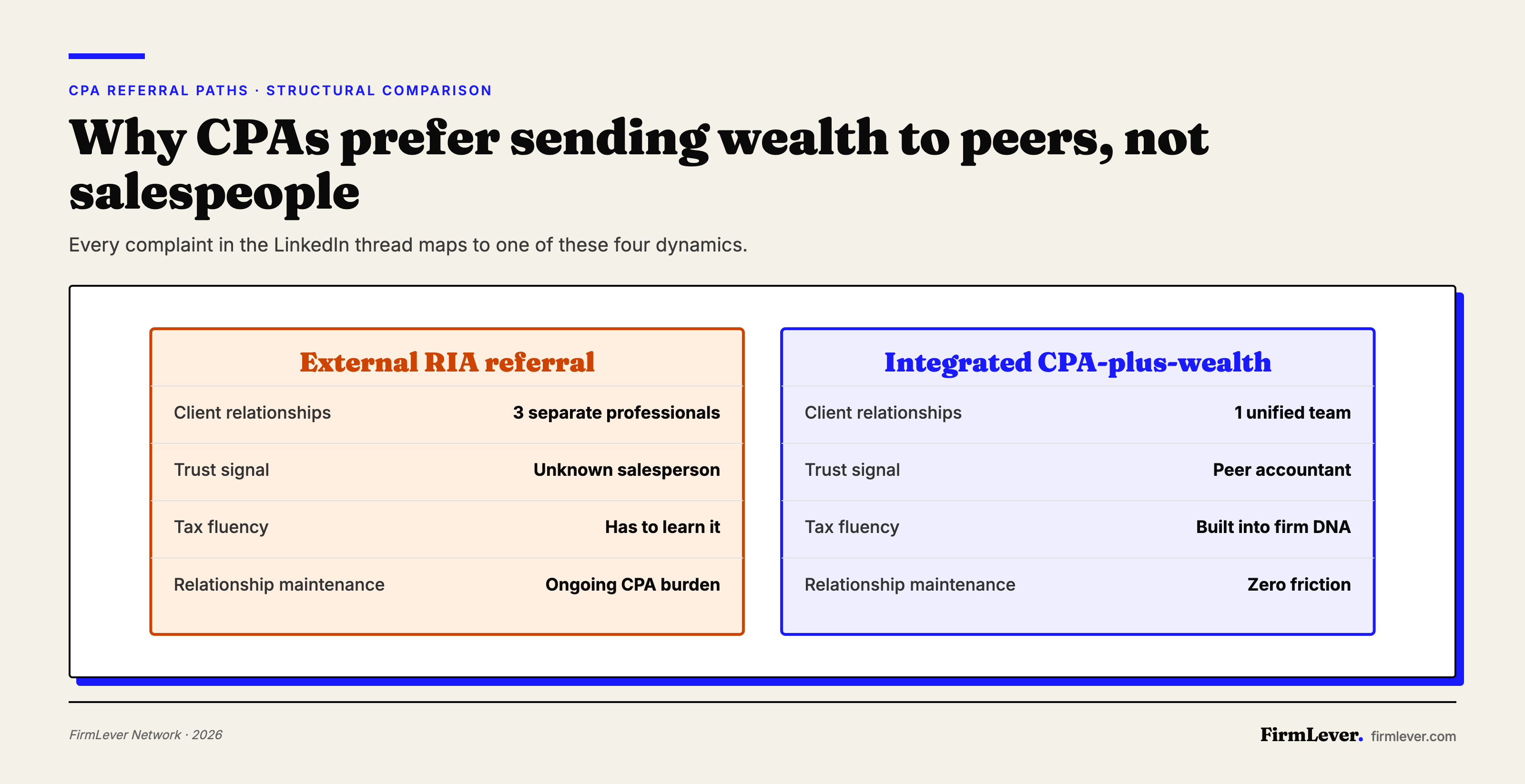
- Brad's supply asymmetry doesn't matter when both ends of the trade are accounting firms running similar businesses.
- Nancy's concern about predatory sales tactics disappears when the recipient is a colleague absorbing a referral, not a salesperson trying to convert your client.
- Robin's objection about client-list hunting goes away because the receiver already has their own clients.
- Brenda's tax-season bandwidth problem vanishes when there's no relationship to maintain. The referring CPA flags the wealth need, hands it off, and gets back to filing returns.
- Kristin's concern about tax literacy disappears because the receiver IS a CPA firm. Tax fluency is the entry ticket, not an aspiration.
Sam's point about reciprocity applies here too. It emerges naturally on the Network, though it's not required. The platform's reputation scoring rewards firms that refer back over time, so relationships that work both ways strengthen over time. Many firms refer wealth out because it's the right move for the client, not to chase a return favor. The sender gets a vetted destination for an opportunity they couldn't act on. The receiver gets referred deals from peers without marketing spend.
What about the tax work?
The honest sender concern: I refer my wealthy client to a CPA-plus-wealth firm and they pick up my tax compliance work too. That's poaching, and it's the reason a lot of CPAs hesitate to send wealth out at all.
Two structural answers, plus one honest one.
The first answer is incentives. A wealth AUM relationship compounds for years as recurring high-margin revenue, while one annual tax engagement is comparatively modest. One good referring CPA can also produce four to eight wealth opportunities a year, so a receiver who grabs the tax work and loses that referral pipeline traded a small win for a much bigger loss. The smart ones know it.
The second answer is the reputation system. The FirmLever Network tracks repeat referrals between firms over time, and receivers who keep producing them rise to the top of future matches. The ones who treat a first referral as a client-acquisition play stop getting matched at all. The whole system runs on the assumption that this is a repeated game, which it is.
The honest answer is what these referrals actually do to the CPA-client relationship. A lot of CPAs are referring wealth out simply because it's the right move for the client, and clients tend to remember which advisor saw the need first. The CPA who proactively brought in a trusted peer to handle the wealth side gets remembered as the strategic one in the room. The CPA who waited for the client to ask gets remembered as the tax preparer.
The numbers as of today
There are 325 firms on the FirmLever Network across 43 states. 158 of them have flagged Wealth/Financial Planning as work they refer out. Only 40 firms offer wealth in-house, which is the audience for our integrated-wealth track at firmlever.com/wealth.
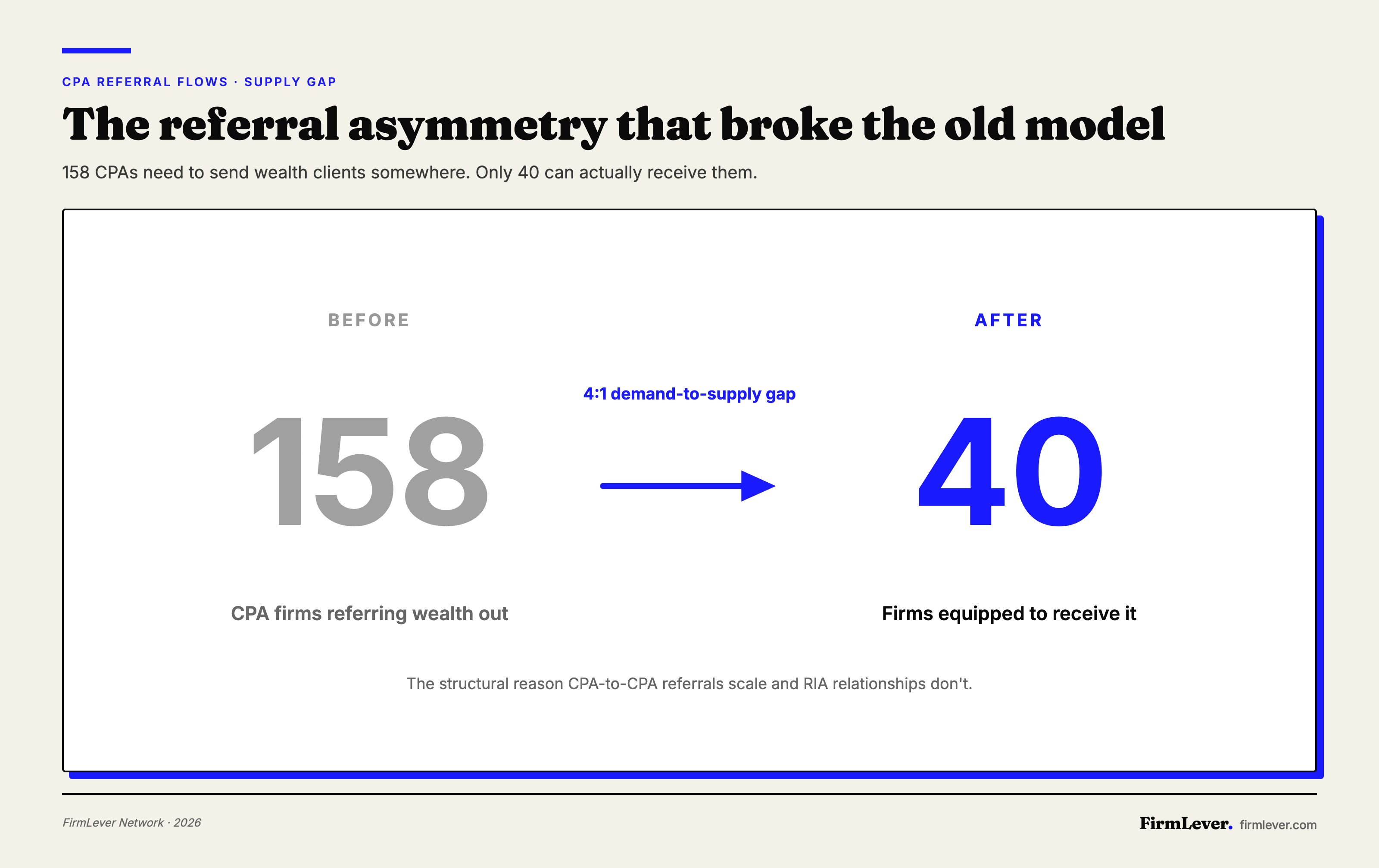
That math is the whole story. Demand sits in 158 firms' books and supply is concentrated in 40. Receiving firms are the bottleneck.
If you run an accounting firm with a real wealth practice—meaning IAR through a B-D, your own RIA, or Series 65/66 with state registration—this inbound already exists. Costanza Casullo asked in that thread if the FirmLever platform could solve this, and the answer is yes. This is what it does.
What this is not
RIA-CPA referrals still work for some. The ones in Cullen's thread proved it. Matthew Jarvis built a third of his $2M revenue from CPA referrals because he put in the work. Kirk Lowe told a great story in the comments about an advisor who grew from $150M to $500M in AUM by giving CPAs a podcast platform first and following up with real value before asking for anything.
Those paths work but require hand-built relationships. The integrated path scales differently because both are running the same kind of firm with trust already in place.
The move
If you're a financial advisor reading this, the LinkedIn thread is your roadmap. Read what the CPAs actually said. Stop bargaining for referrals and start delivering value to their clients with no expectations attached. That's what Matthew, Kirk, and Robin all said works.
If you're an accounting firm with an in-house wealth practice, you're the destination 158 firms on the network are looking for. Apply at firmlever.com/wealth. Every application gets reviewed personally.
And if you're a tax-only CPA who's been shipping wealth clients out to outside RIAs out of habit, there's now a peer-firm option worth knowing about.
Marc
P.S. — Cullen's original post is here. Worth reading for the comments alone, because the CPAs in there are giving a pretty honest answer to the referral question I've ever seen on LinkedIn.