Buying MSP-Focused Accounting Firms: Why They Trade at 2.5x Revenue
MSP-niche accounting firms are commanding 1.8x-2.5x revenue in 2026. Here's what drives the premium and how to vet the expertise.


In M&A for accounting firms, specialization matters. Generalist firms trade at traditional multiples. Firms with deep expertise in IT and Managed Services Providers (MSPs) command real premiums. The reason is simple: MSP accounting is nothing like accounting for construction companies or retailers. The growth of AI services, managed security, and cloud automation has created financial complexities that only some firms handle well.
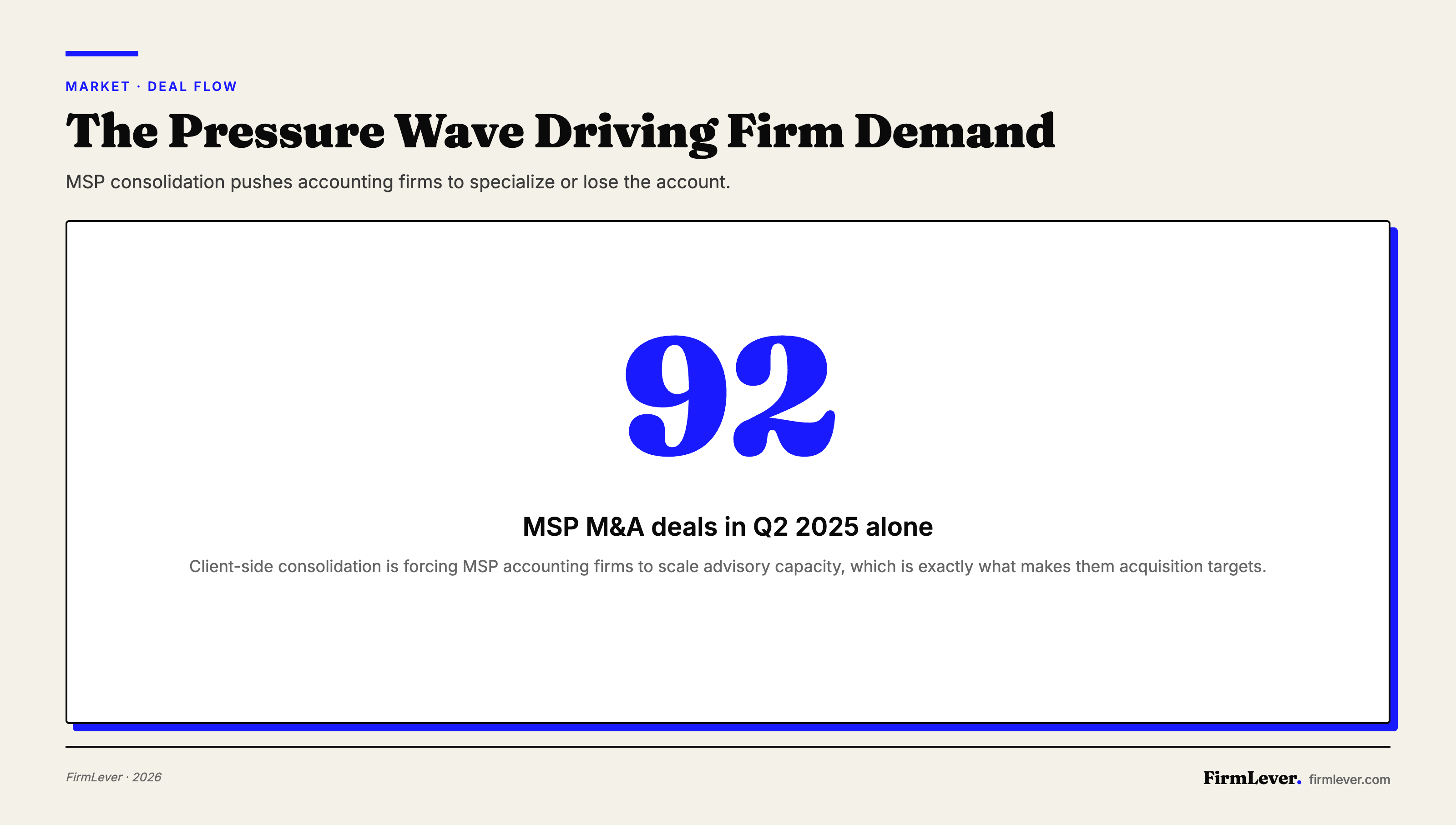
In Q2 2025 alone, the MSP sector recorded 92 announced M&A transactions. That consolidation among the clients puts pressure on their accounting partners to scale up, offer real advisory services, and handle complex due diligence. Buyers who find accounting firms serving high-growth IT clients are buying a derivative of the tech boom with the stability of professional services. Look at The Firmlever Weekly Roundup: Issue #31 and the pattern is obvious: specialization drives valuation.
The strategic appeal: why the IT/MSP niche commands a premium
Start with the client base. Public IT Services and Consulting firms trade at median EV/EBITDA multiples around 13.0x in the US and 10.2x in Europe. When an accounting firm holds a roster of those clients, the firm itself becomes a strategic asset. What protects that asset is the specialized knowledge required to keep the clients.
Accounting firms in this space act as strategic partners. They help MSPs handle subscription billing, churn analysis, and SaaS metrics. The 2025 merger of Baker Tilly and Moss Adams created a $7 billion firm, which tells you scale plus industry depth works. For mid-market buyers, the real opportunity is picking up boutique firms that actually speak the financial language of IT.
Technology shifts in 2025 and 2026, including the explosion of AI services and Managed Detection and Response (MDR), have rewritten MSP cost structures. An accounting firm that understands software capitalization and cloud FinOps is now essential, not optional. That stickiness reduces client churn and raises the Lifetime Value (LTV) of the practice, which matters a lot when you're pricing an offer.
Decoding the DNA: the unique services of MSP-focused accountants
A standard accounting firm handles tax compliance and bookkeeping. MSP specialists sit at the intersection of law, finance, and technology. Here's what to look for.
1. The R&D tax credit fortress (Section 41 & Section 174)
The R&D tax credit is where specialists separate themselves from generalists. For IT services companies building proprietary software or integrating AI, the credit is real money. But the Section 174 changes, which require amortizing R&D expenses instead of immediate expensing, made the math a lot more complicated.
Good niche firms have worked out how to identify qualifying activities, like developing multi-cloud governance architecture, and document them to survive IRS scrutiny. They also advise MSPs on how to structure engineering teams to capture more of the benefit. An accounting firm without deep expertise in Section 41 claims is a liability to an IT client, not an asset.
2. Mastering ASC 606 and SaaS revenue recognition
MSP contracts make revenue recognition genuinely hard. A single contract might bundle hardware, ongoing support, implementation fees, and variable usage charges. Under ASC 606, each of those performance obligations has to be separated out and recognized on its own schedule.
Specialists understand:
- Contract asset vs. contract liability: tracking unbilled receivables against deferred revenue.
- Variable consideration: estimating revenue when usage changes month to month.
- Bundled pricing: allocating transaction prices to separate performance obligations based on standalone selling prices.
If a target firm can't walk you through how they allocate revenue on a hybrid cloud contract, they're not a specialist.
3. FinOps and cloud spend management
FinOps is the newer service offering that actually matters. As MSPs resell AWS, Azure, and Google Cloud, their cost of goods sold moves constantly. Niche accounting firms now offer FinOps as a service, analyzing cloud bills, tagging resources for cost allocation, and helping clients protect margins. That turns the accountant into someone who shapes profit rather than just records it.
Valuation drivers in 2026: what buyers must measure
Valuing a niche firm takes more than looking at EBITDA. You have to evaluate revenue quality and how deep the intellectual property actually goes. Before you make an offer, get the baseline from The Complete Guide to Valuation of Accounting Practice: What Is Your Firm Really Worth in 2026?. Then layer the niche-specific factors on top.
The advisory ratio
At generalist firms, tax and compliance are usually 70% of revenue. At high-value MSP firms, you want to see an advisory ratio where consulting work (virtual CFO, FinOps, M&A readiness for clients) accounts for 40-50% of revenue. That mix tells you the firm is actually embedded in client operations.
Client concentration risks vs. vertical dominance
Client concentration is usually a red flag. In this niche, sector concentration is a good sign. A firm that gets 80% of revenue from IT services is more valuable than one at 10%, because the operational efficiencies compound. Staff already speak MRR and ARR, so training time and errors drop.
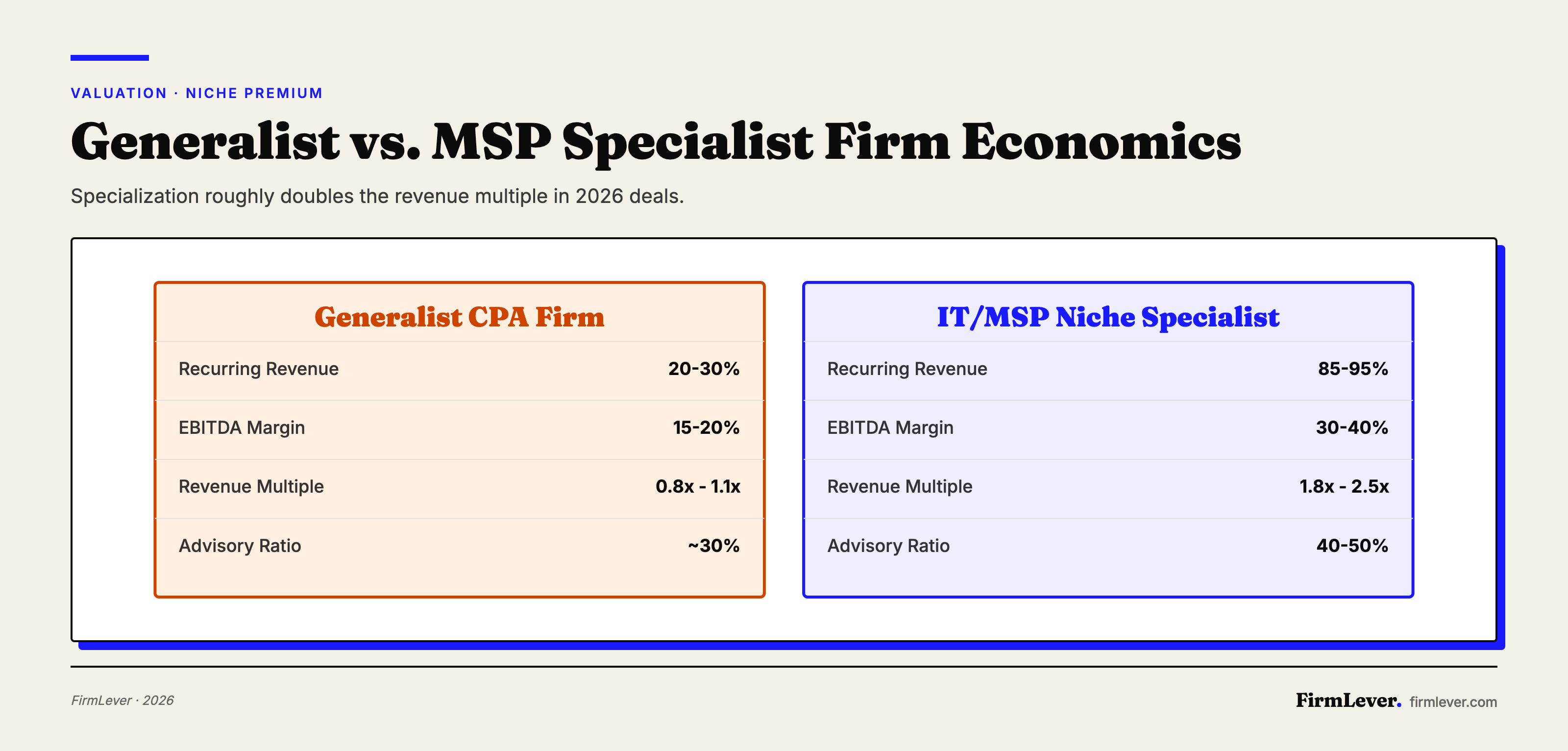
Here's a comparison of valuation multiples based on our 2026 market analysis:
| Firm Type | Avg. Recurring Revenue % | Typical EBITDA Margin | Valuation Multiple (Revenue) |
|---|---|---|---|
| Generalist CPA Firm | 20-30% | 15-20% | 0.8x - 1.1x |
| Cloud Accounting Firm (General) | 60-70% | 20-25% | 1.2x - 1.5x |
| IT/MSP Niche Specialist | 85-95% | 30-40% | 1.8x - 2.5x |
For more on the KPIs behind these multiples, see The Ultimate Glossary of Accounting Firm Metrics, KPIs & Valuation Terms (2026 Edition).
Due diligence: how to verify expertise
Once you have a target, how do you confirm they're real experts and not just good at marketing? Diligence has to dig into how they actually deliver the work.
Scrutinize the tech stack
MSP-focused accounting firms can't run on spreadsheets. Check for integrations with MSP-specific tools like ConnectWise, Autotask, or HaloPSA. Are they using specialized subscription billing software like SaaSOptics or Maxio? Those tools are the sign they've actually automated the complex revenue recognition work their clients need.
Review the equity compensation advisory
Lots of IT startups pay people in stock options (ISOs, NSOs) and RSUs. That means 409A valuation support and cap table management. Ask to see sanitized client files for equity compensation work. If the firm is outsourcing that or skipping over the details, they're leaving money on the table and putting clients at risk.
Assess knowledge of software capitalization
Ask the partners to walk you through how they distinguish research costs (expensed or amortized) from development costs (capitalized) under GAAP and tax law. The answer tells you how deep they actually go. Generalists often get this wrong, which leads to restatements when a client goes out to raise money. For more on risk in tech-heavy sectors, see The Complete Guide to Cloud Accounting Firm Acquisition.
2026 projections and future opportunities
The market for these firms is getting more competitive. Private equity is already active in MSP deals and is starting to see that owning the financial infrastructure, meaning the accounting firms, is a picks-and-shovels play on the sector.
AI will drive future acquisitions. Firms that have deployed AI to pull data from MSP ticketing systems straight into financial ledgers will stand out. That kind of automation produces higher margins and the scalability manual firms can't match. Crete Professionals Alliance putting $500M+ into AI-powered roll-ups shows where this is going.
Integrated compliance is the other growth area. MSPs face strict security requirements (CMMC, SOC 2). Accounting firms that pair financial audits with SOC 2 readiness consulting will get the top valuations, because buyers want IT security and financial integrity in one place.
For a deeper set of questions to ask sellers about these trends, see The Ultimate Accounting Firm Metrics & Valuation FAQ: 150+ Questions Answered (2026 Edition).
Frequently asked questions
What is the biggest deal-breaker when buying an accounting firm specializing in MSPs?
A weak grasp of Section 174 amortization rules. If a firm has been improperly expensing R&D costs for software clients, you're buying a liability made of tax penalties and restatements. Always run a specific tax audit on their top 5 clients during diligence.
How does churn differ in MSP accounting firms compared to traditional firms?
Traditional firms see churn when a client dies or leaves. MSP accounting firms face downstream churn. When their MSP clients lose customers, the accounting fees (often tied to revenue or transaction volume) shrink too. Buyers have to analyze churn at the clients' customers level to understand revenue stability.
Why is FinOps expertise important for valuation?
FinOps expertise turns the accountant from a commodity provider into a profit center. When the firm saves MSPs money on cloud spend, it can charge real fees for doing it. Firms with a dedicated FinOps practice tend to trade at a 20-30% premium because the advisory revenue is high margin.
Should I prioritize firms that use specific software like ConnectWise?
Yes. Being fluent in the MSP ecosystem's source of truth (ConnectWise, Autotask) matters. It means the accounting firm can pull data directly for invoicing and profitability analysis without manual entry. That operational efficiency is a big part of why EBITDA margins in this niche are higher.
How do recent M&A trends in the MSP sector affect accounting firm buyers?
Heavy M&A activity in MSPs (92 deals in Q2 2025) means accounting firms often end up helping their clients buy or sell businesses. That produces transaction advisory fees on top of recurring work. A firm with a track record of supporting client exits is more valuable because the revenue comes from two sources instead of one.
Buying IT services and MSP accounting firms is a specialist game. You have to look past topline revenue and understand what actually makes these firms hard to replace. As IT keeps growing as a share of the global economy, the accountants keeping score for it become valuable professional services assets. Focus on deep technical expertise, from FinOps to R&D tax credits, and you'll get a high-growth asset that holds its value.
To stay current on niche consolidation and see our latest read on market multiples, subscribe to the blog. We publish the data you need to make decisions in a fast-moving M&A market.
Marc
P.S.